Professor Christian Gollier and Dr Alessio Terzi talk to Richard Westcott about designing climate policy that delivers in the real world, how the costs and benefits of the transition are shared across people, places, and generations, and what’s required to build the trust and institutions that can sustain climate action over decades.
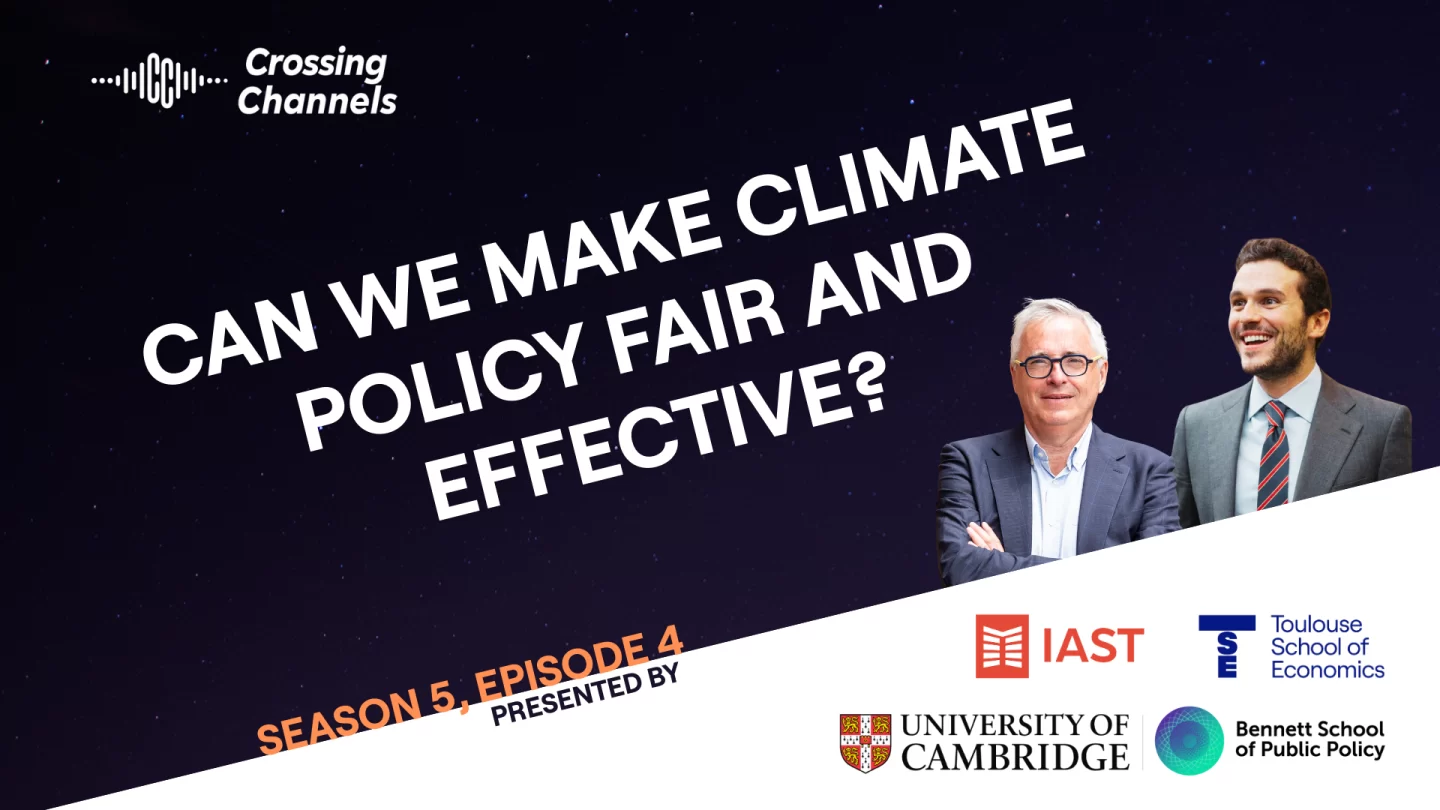
In this episode of Crossing Channels, Richard Westcott talks to Dr Alessio Terzi from the Bennett School of Public Policy, and Prof Christian Gollier from the Toulouse School of Economics, about what a “fair” climate transition could look like when the costs are local, the benefits are global, and the politics are hard.
They explore why decarbonisation is a whole-economy transformation, what it means for jobs and places, and why the narrative matters as much as the technology.
The conversation also looks at carbon pricing and redistribution, the credibility problem of long-term policy, and what kinds of institutions and policies can keep people on board in the years ahead.
Listen to this episode on your preferred podcast platform
With thanks to:
- Audio production by Alice Whaley
- Associate production by Burcu Sevde Selvi
- Visuals by Tiffany Naylor and Pauline Alves
More information about our host and guests:
Podcast host
Richard Westcott is an award-winning journalist who spent 27 years at the BBC as a correspondent/producer/presenter covering global stories for the flagship Six and Ten o’clock TV news as well as the Today programme. Last year, Richard left the corporation and he is now the communications director for Cambridge University Health Partners and the Cambridge Biomedical Campus, both organisations that are working to support life sciences and healthcare across the city.
Podcast guests
Prof Christian Gollier’s research spans the fields of economics of uncertainty, environmental economics, finance, consumption, insurance and cost-benefit analysis, with a particular interest in long-term sustainable effects. He is a Fellow of the Econometric Society. Christian has published more than 140 articles in international scientific journals, as well as 10 books on risk, including “The Economics of Risk and Time” (MIT Press), which won the “Paul A. Samuelson Award (2001). He founded the Jean-Jacques Laffont / Toulouse School of Economics Foundation with Jean Tirole in 2007. He was its director from 2009 to 2024 (with a hiatus in 2015-2016). From June 2023 to October 2025, he was the first director of the “Grand Etablissement TSE”.
Dr Alessio Terzi is an economist working at the intersection of academia, think-tanks, and policy. He is Assistant Professor at the Bennett School of Public Policy, Cambridge, where he also directs the MPhil in Public Policy, and is an Adjunct Professor in Economics at Sciences Po. He is a member of the World Economic Forum Global Future Council on Equitable Transition. His 2022 book ‘Growth for Good: Reshaping Capitalism to Save Humanity from Climate Catastrophe’ (Harvard University Press) was a Financial Times summer reading favourite and a Foreign Affairs best book of the year. @terzibus.bsky.social
The views and opinions expressed in this post are those of the author(s) and not necessarily those of the Bennett School of Public Policy.