In their new paper with Diane Coyle and Rebecca Riley, John Poquiz and Nghi Nguyen explore the organisational requirements for AI adoption. Their research shows that firms with stronger management practices are more likely to adopt AI – in contrast to other technologies like robotics or specialised software. Their findings suggest that AI systems are not “plug and play” gadgets you can simply purchase and turn on. This means UK policymakers shouldn't focus on the technology; instead they need to think about helping firms improve how they are run.

There is a strong sense of excitement for the potential of Artificial Intelligence (AI) to usher in a new era of economic growth. In our previous blog we explained that while the cost of using popular Large Language Models (LLMs) has continued to fall and AI models are becoming more accessible, adoption across firms remains uneven. We see faster uptake from larger firms compared to others. If AI adoption remains the exclusive domain of a few tech-savvy players with resources, over time, this could contribute to the widening of the productivity gap between the big firms and Small and Medium-sized Enterprises (SMEs), deepening one of the UK’s most persistent economic challenges.
In our new working paper, we explore the implicit barriers to AI adoption.[i] Using data from the Management and Expectation Survey (MES),[ii] we find that AI is not a technology that firms can simply use off-the-shelf. The successful adoption of AI depends heavily on a firm’s “organizational capital”, specifically, how well businesses are being managed. Additionally, the managerial practices to AI adoption are not as relevant for other technologies such as robotics. Policy efforts should be mindful that programmes that work well for encouraging the adoption of some technologies may not work well for others.
Technology and structured management
Economists have long argued that there is a strong link between the adoption of new technologies and the management practices within a firm. Businesses that adopt new technologies are usually those with better structured management. This is because getting the most out of new technology often requires investment in retraining talented workers, redesigning processes, and rethinking business strategies. As a result, when a firm first adopts a new technology, productivity can initially fall before the gains are realised. Economists call this pattern the Productivity J-Curve.
In our study, we were interested in understanding the extent to which management practices facilitate AI adoption. The main idea is that structure management help firms navigate organisational transitions more effectively.
Early evidence on management practices and AI
The MES defines structured management through four distinct dimensions:
- Continuous improvement when facing challenges
- Reviewing of key performance indicators (KPIs)
- Awareness of targets and target-based incentives
- Hiring and promotion practices
Key performance indicator (KPI)-related practices capture the range of performance indicators and how frequently a business review them, while those relating to target-setting refers the degree of which managers and staff are aware of business goals, and whether bonuses are tied to meeting them.
Each dimension could support AI adoption in different ways. Management focused on continuous improvement allow firms learn from an initial a pilot phase. KPI tracking and systematic targets provide a common language across different departments, which in turn, allows for the coordination on AI priorities. Sound employment practices build the digital skills needed to identify use cases and work with new tools. Ultimately, a this will also allow businesses to reap potential productivity benefits of AI adoption much faster.
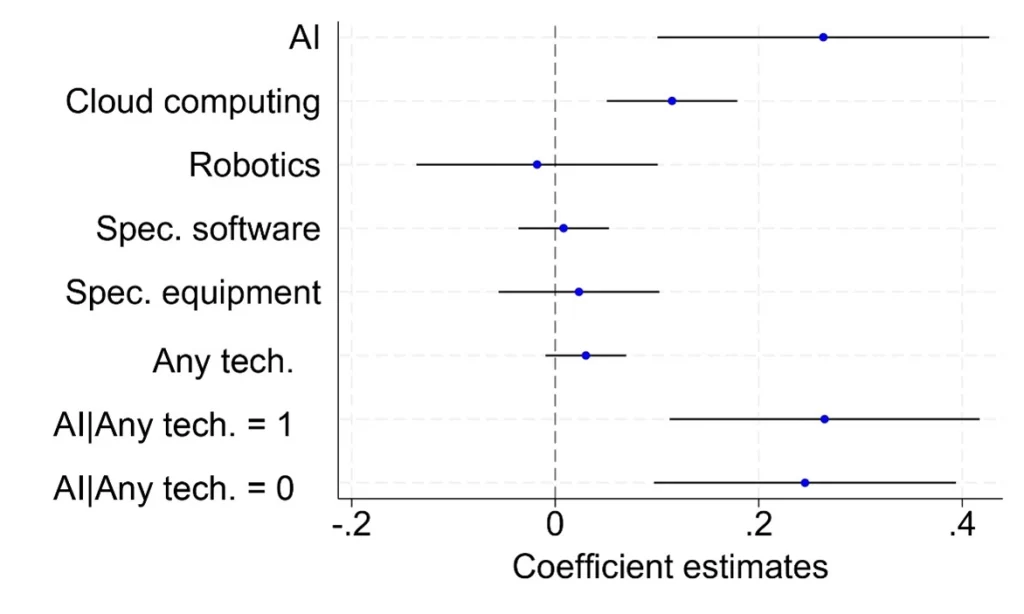
In our analysis of UK firm-level data, we find that structured management[iii] is positively associated with early AI adoption,[iv] even after accounting for differences in labour productivity, employment size, business age, industry, and location.
Figure 1 shows these results. A blue dot to the right of the vertical dashed line indicates the effect on management on the probability of adoption, while the black lines provides the range of possible values.[v] The further the blue dot is to the right, stronger the effect.
Figure 1: Effect of management practices in 2020 on technology adoption in 2023
Source: Authors’ calculations; MES.
Interestingly, management practices as measured in our paper do not seem to relate to whether a firm uses robotics, specialised software or specialised equipment. It does play a small role in cloud computing, but that effect is less than half of what we see with AI. This may suggest that AI is unique and requires a specific kind of management skill that goes beyond just being ‘good with technology’ in general.
It’s important not to overstate this. We acknowledge that these technologies are at different stages of maturity (see discussion in the paper). Nonetheless, at least at the early stage of AI diffusion, our finding suggests that the organisational requirement to AI adoption is much higher compared to what is required for other technologies.
Which managerial aspects matter most?
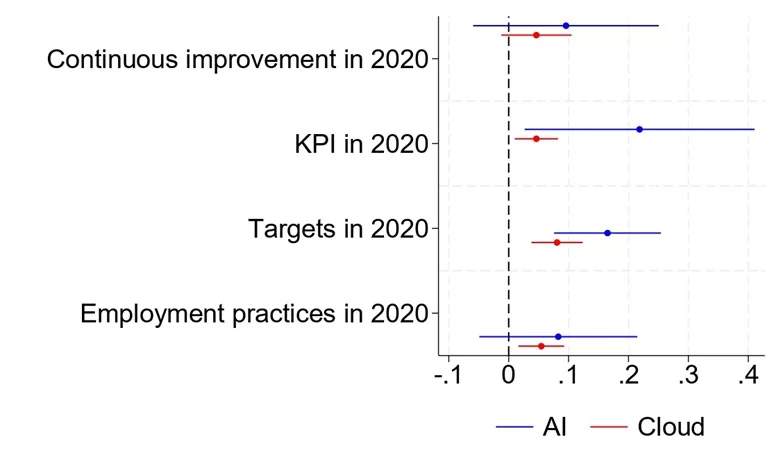
We also explore which of the four dimensions of management practices is driving our results. We find that firms that track KPI and set clear targets are more likely to adopt AI.
KPI tracking and target-setting may matter most for AI adoption for several reasons. First, they signal a firm’s existing capacity to collect and use data, which is essential for training, customising, and monitoring AI tools. Second, they may reflect the goals that motivate adoption in the first place, such as improving the tracking of business operations. Third, and perhaps most practically, AI is rarely implemented in isolation. It cuts across teams, roles, and work flows. KPIs and target-setting help solve a coordination problem that AI adoption tends to create. They establish explicit expectations about who does what and by when, reducing the confusion between departments trying to implement new systems together. Further research is need to identify which of these mechanisms is the most important.
Is it the same for other technologies? We do not find a strong link between these the different elements of management and the adoption of robotics, specialised software or specialised equipment. While we find a positive effect of practices related to KPI, targets, and employment practices on cloud computing adoption, the magnitude of there is smaller compared to those for AI adoption.
Figure 2 illustrates these results for AI and cloud computing. The blue dots for KPI and Targets sit further to the right of the zero line than those for other management dimensions, reflecting their larger positive association with AI adoption.
Figure 2: Which aspect of management matters most for AI and cloud computing adoption?
Source: Authors’ calculations; MES
Policy implications
Our findings suggest that adopting AI comes with different challenges compared to other technologies, and that management practices are one of them. We think that this is primarily because AI outputs require human evaluation and interpretation, making coordination and structured monitoring are more important for AI compared to other technologies. It may also reflect the fact that AI products are still relatively new. Unlike with more mature technologies, businesses cannot yet rely on the peer learning or vendor to guide them through adoption.
What this means is that policies that work well for encouraging the adoption of some technologies may not work well for others. Initiatives that successfully drives the adoption of robotics, for instance, may do little to boost AI adoption if the underlying organisational barriers are different.
Finally, our findings imply that programmes aimed at encourage AI uptake may see better returns if they are designed to help businesses build the data-driven decision-making culture, as opposed to blanket subsidies. If the UK is serious about realising the productivity gains that AI promises, helping more businesses to make that organisational transition must be part of the plan.
Read the report: More than just plug and play: Early evidence on organisational capital and AI adoption
[i] In the context of our study, we qualify technology adoption as a technology being actively used as part of a firm’s processes or method, compared adopters against firms that considers the technology relevant to their business but have not yet implemented it. We also exclude firms who are testing the technology but, but not formally using it as part of their process. Our sensitivity analysis shows that even if we broaden the definition of adoption to include firms testing the technology, it does not change the result.
[ii] The MES was jointly developed by Office for National Statistics and Economic Statistics Centre of Excellence (ESCoE)
[iii] In this case, structured management or total management quality is measured as an average score across the four dimensions we discussed earlier.
[iv] In the paper, we measure the management score in 2020 as it relates to AI adoption in 2023 to mitigate reverse causality.
[v] Assuming a confidence level of 95%.
The views and opinions expressed in this post are those of the author(s) and not necessarily those of the Bennett School of Public Policy.