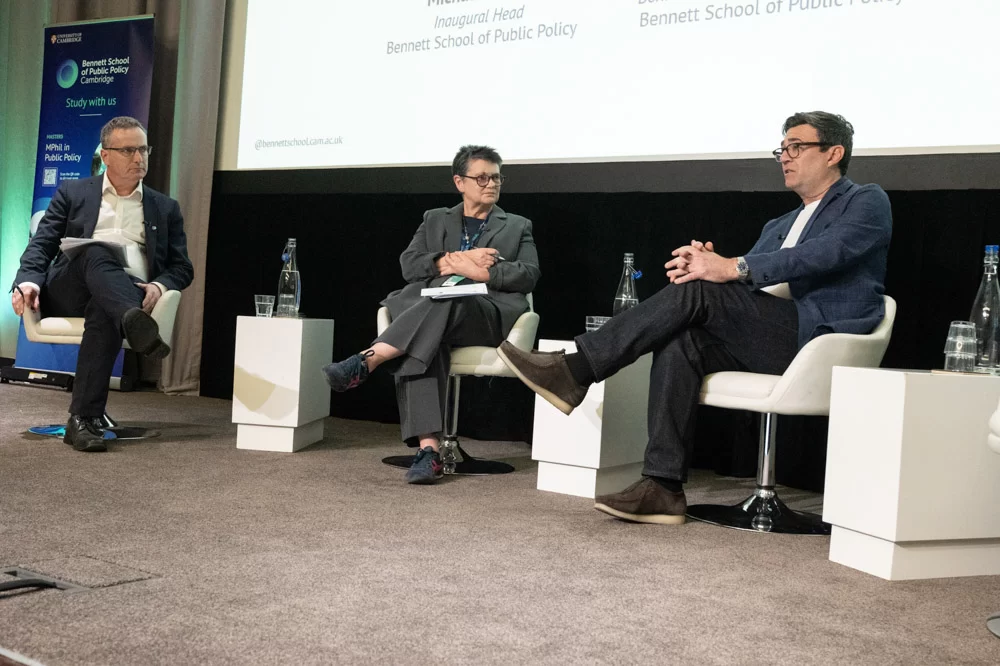
Andy Burnham took centre stage at our Annual Conference in March 2026, joining Bennett School directors Prof Michael Kenny and Prof Diane Coyle for a headline session on the future of British politics. With his possible return to Westminster as a challenger for both the leadership of the Labour Party and the country, Dr Beth Kitson and Owen Garling examine the conversation to see how the lessons of Burnham's mayoral tenure might frame his approach to leading the nation.
Grounded in his three terms managing a major city-region, the thesis that Andy Burnham outlined proposes a fundamental shift away from Westminster’s centralised, top-down mandates toward a streamlined, place-based delivery model. At the heart of this approach is what he terms “Manchesterism”, a philosophy dictating that economic progress must go hand in hand with social progress.
Burnham argued that the last 40 years of centralised policy have broken the link between economic growth and public welfare. To fix this, his platform advocates for a “greater degree of public control” over essential drivers of growth, such as housing, energy, water, and transport. In his view, public control is a prerequisite for growth, rather than a reward for it. The primary, operational proof of concept for this model is Greater Manchester’s Bee Network. Burnham explained the precise statutory and historical mechanisms used to bring the previously deregulated bus system back under local authority control. Under this regulated model, the city-region runs services a third cheaper per kilometre than its privatised predecessor while protecting a strict £2 fare cap and buying back local bus depots.
However, Burnham’s vision extends far beyond local transport, indicating that turning Manchesterism into a national policy programme requires a fundamental restructuring of Whitehall’s core machinery. In conversation, he offered a sharp critique of the HM Treasury, describing it as a department structurally geared toward controlling public spending rather than actively promoting growth. He anchored this perspective in an anecdote from his time as a HM Treasury minister in 2007, when regional rail funding for the North was blocked because it did not pass a narrow Green Book economic test.
Further, Burnham questioned the necessity of national bodies like Homes England and Skills England, suggesting that centralised agencies should not oversee matters as inherently local as housing and skills. In his view, this national oversight can create an inefficient “halfway house” that leaves local leaders heavily dependent on central government for funding.
While these arguments outline a radical vision for state reform, Burnham’s strategy for achieving it relies on sustained persuasion and collaboration rather than a direct institutional battle. Despite his sharp critique of Whitehall, he pointed out that the HM Treasury is already becoming significantly awake to place-based policy because Greater Manchester’s strong economic growth has begun to change officials’ minds. This suggests that his roadmap for change relies on using this proven, local economic data as the empirical evidence needed to guide and shift central Whitehall policy from within.
This need for careful prioritisation is equally evident in his calls for wider political reform. Citing his disillusionment with Westminster’s adversarial, party-first culture, Burnham spoke of his experiences regionally of a more collaborative solutions-focused politics and championed adopting proportional representation nationwide, reforming the parliamentary Whip system, and replacing the House of Lords with an elected senate representing the nations and regions.
While Burnham’s record provides a compelling blueprint for regional governance, scaling these ideas to a national executive poses three significant structural questions.
First, the challenge of prioritisation. The sheer scale of Burnham’s potential agenda is immense. Overhauling the voting system, expanding public control over core utilities, and rewriting the constitutional fabric of Parliament are each massive, multi-year undertakings. In a climate of increasing uncertainty, any government faces immediate crises that can easily derail long-term structural changes. If he returns to Westminster, can a Burnham-led executive realistically prioritise deep institutional restructuring without losing momentum on urgent, day-to-day public service delivery and with an electoral mandate inherited from the previous administration? It remains debatable whether a prime minister could realistically choose to prioritise complex constitutional or Treasury overhauls over immediate economic and public service demands.
Second, party management and ideological alignment. While Keir Starmer’s government has been, by and large, uninterested in constitutional reform, Burnham represents a potential leader who is deeply invested in this area. However, he would have to pick his priorities carefully within a broader Labour Party that remains deeply split on these issues, if not completely uninterested. Winning the leadership is only the first step; maintaining unity while pursuing policies like proportional representation or abolishing the House of Lords would face deep-seated institutional resistance from within traditional party structures. Navigating this internal friction while trying to build a collaborative political model will test his leadership to the limit.
Third, perhaps the ultimate political test involves the psychology of central power itself. Burnham’s entire platform is built on dismantling Westminster orthodoxy and shifting economic levers away from the centralised executive to an empowered network of regions. Yet, history shows that the view from Downing Street often alters a perspective on central control, a shift seen when both Tony Blair’s early push for devolution and David Cameron’s promises of radical localism ultimately yielded to top-down Whitehall mandates. Will a leader who has successfully acquired the vast levers of the British state truly be willing to immediately dismantle and devolve that power? Walking this tightrope, using centralised power to decentralise the state, remains the fundamental paradox of his national vision.
The views and opinions expressed in this post are those of the author(s) and not necessarily those of the Bennett School of Public Policy.