In the final episode of the fifth series of Crossing Channels, Richard Westcott talks to Prof Tim Whitmarsh and Cammie Curtin about how culture shapes our identities, behaviour and relationships – from the ancient Greek and Roman worlds to the societies we live in today. They explore how shared norms and rituals foster cooperation, why some cultural practices endure while others change, and what understanding cultural differences can teach us about belonging and public policy.
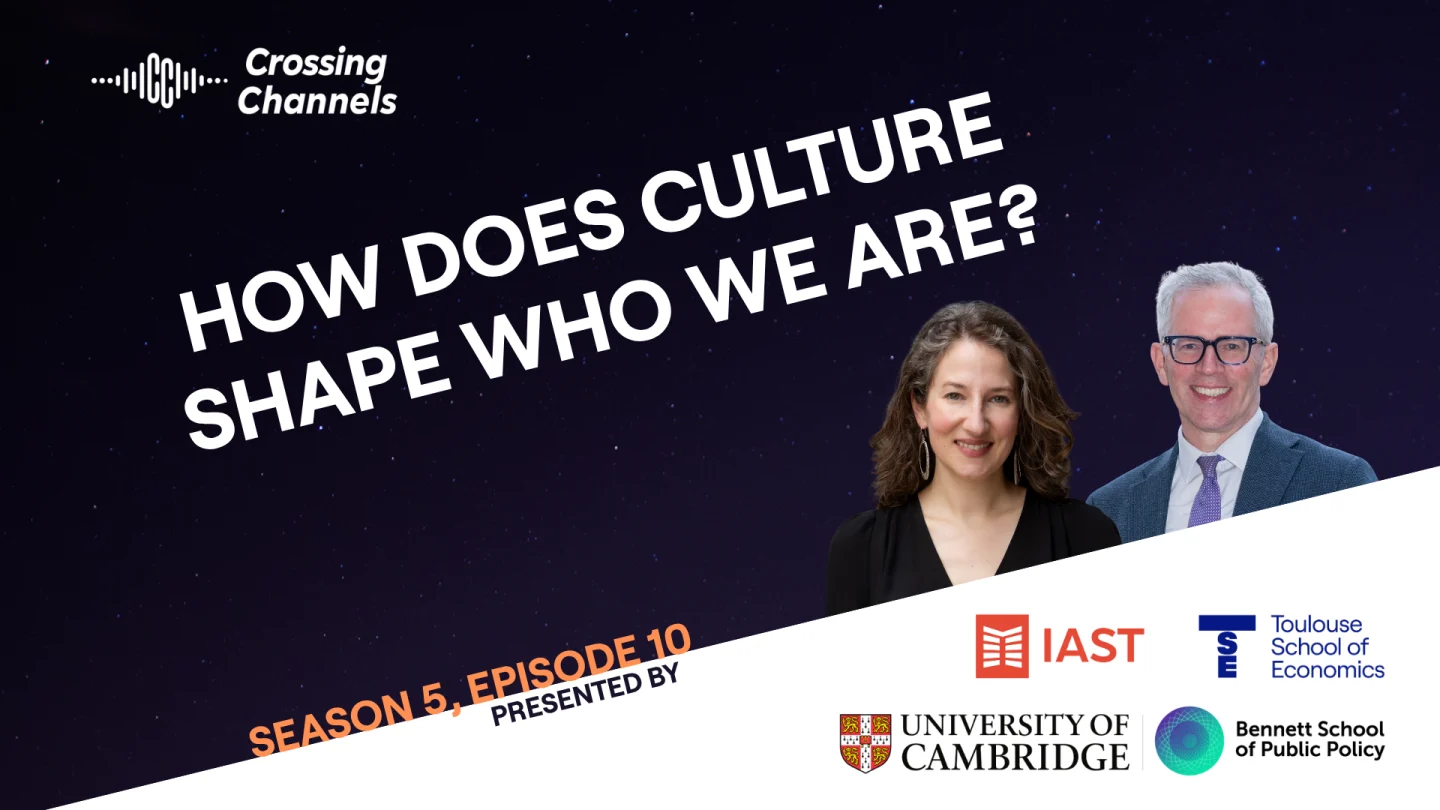
In this episode of Crossing Channels, Richard Westcott talks to Prof Tim Whitmarsh from the University of Cambridge and Cammie Curtin from the Toulouse School of Economics about how culture shapes who we are.
They explore how culture influences the way people think and behave, how social norms and institutions support cooperation, and why practices that may seem universal can vary widely across societies.
The conversation looks at identity and cultural change in the ancient Greek and Roman worlds, how rituals and shared obligations bind communities together, why some cultural traits endure while others change, and what understanding cultural differences can teach us about belonging, public policy and social cooperation.
For more information about the Crossing Channels podcast series and the work of the Bennett School of Public Policy and Toulouse School of Economics, visit our websites at https://www.bennettschool.cam.ac.uk/ and https://www.tse.fr/
Follow us on Linkedin, Bluesky and X.
With thanks to:
- Audio production by Alice Whaley
- Associate production by Burcu Sevde Selvi
- Visuals by Tiffany Naylor and Pauline Alves
More information about our host and guests:
Podcast host
Richard Westcott is an award-winning journalist who spent 27 years at the BBC as a correspondent/producer/presenter covering global stories for the flagship Six and Ten o’clock TV news as well as the Today programme. His last role was as a science correspondent covering the covid outbreak, but prior to that he was the transport correspondent. Richard left the corporation to become the communications director for Cambridge University Health Partners and the Cambridge Biomedical Campus, both organisations that are working to support life sciences and healthcare across the city.
Podcast guests
Cammie Curtin, is an interdisciplinary social scientist studying cultural evolution working at the Toulouse School of Economics. Broadly, her research investigates how cultural traits evolve and how they shape human social psychology and behaviour. Her recent work examines how social norms and institutions sustain cooperation in indigenous communities of Oaxaca, Mexico, where she does fieldwork. She leverages methods from anthropology, psychology, and economics, including qualitative and quantitative ethnography, psychological surveys, behavioural economics games, and work with secondary data. She is currently a Research Fellow at the Institute for Advanced Study in Toulouse at the Toulouse School of Economics. She received her PhD in Human Evolutionary Biology from Harvard University.
Tim Whitmarsh, is Regius Professor of Greek at the University of Cambridge, and a Fellow of Trinity College, Cambridge. A specialist in the literature, culture and religion of ancient Greece, he is the sole author of nine books, including Battling the Gods: Atheism in the Ancient World (Knopf 2015) and Dirty Love: The Genealogy of the Ancient Greek Novel (Oxford University Press 2018). He is editor-in-chief of the Oxford Classical Dictionary (5th edition), and edits book series for Oxford University Press and Cambridge University Press. He was Principal Investigator for a major AHRC project Greek Epic of the Roman Empire: A Cultural History (2014–17), which will (among other things) produce the first complete set of translations of this relatively neglected corpus of Greek poetry.
The views and opinions expressed in this post are those of the author(s) and not necessarily those of the Bennett School of Public Policy.