The government’s number one mission of kickstarting growth could leave already left behind places even worse off. Geoff White, Peter Tyler and Colin Warnock argue there is a real risk of this happening. In the absence of well-resourced spatial policies targeted on areas most in need, great swathes of the country could be left with wasted productive capacity and with relative deprivation becoming even more embedded.

The recently published 2025 Index of Multiple Deprivation (IMD) reminds us just how geographically divided England is in terms of income, employment, health and other deprivation measures (see Figures 1 and 2). Moreover, little has changed in the last six years. Around 80% of the highly deprived neighbourhoods in IMD 2025 were also the most deprived in IMD 2019. These inequalities are also evident in spatial productivity gaps which are large and persistent.
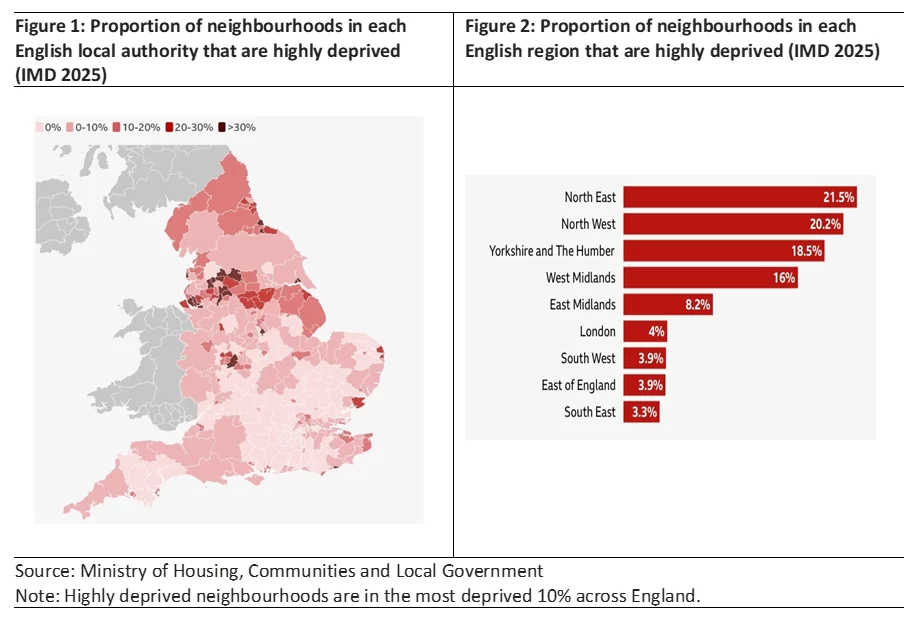
The UK has larger spatial inequalities than many advanced economies, limiting competitiveness and growth. Significant under‑use of productive capacity, particularly in the North East and North West, leads to major disparities in living standards across the country.
If the most disadvantaged neighbourhoods in England had experienced productivity growth at the same rate as the rest of country through the 2010s, they would have added another £9.8 billion per annum to national output. That is equivalent to £2,618 of additional annual economic output per household in the most left behind places identified in the recent Neighbourhood Commission report.
There is clear evidence that effective action on spatial inequalities requires a strategic commitment to rebalancing and directing substantially more resources to the most disadvantaged areas. Central and local government efforts must be coordinated through a more empowered, ‘place‑based’ devolved approach. Strengthening local policymaking capacity is also essential. These principles guide our assessment of recent policy developments.
The government’s growth mission is to deliver “higher living standards in every part of the UK”. Yet, its national strategies emphasise the importance of unlocking the potential of the highest growth sectors and in the places where they are concentrated. This could result in left-behind places being left further behind. In our view, the growth ambition needs to be explicit in requiring a narrowing of the gap between the most and least deprived parts of the country. Central government departments must play their part through demand as well as supply side policies. In the 10% most disadvantaged neighbourhoods there are only 47.5 jobs per 100 people compared with 84.5 for the 10% least disadvantaged. Yet, the need to address a demand deficit is only referred to once in the priorities shared between central government and mayoral authorities – in the priorities for South Yorkshire.
As central government controls key levers to address place‑based demand deficits—such as procurement, infrastructure investment, government office location and fiscal incentives—it must take responsibility and pursue a clear spatial rebalancing mission through its departmental spending plans, actions and reporting.
Total funding per year has been reduced to less than £1 bn for specific place based initiatives (Industrial Strategy Zones (ISZs), the Local Growth Fund (LGF) and Pride in Place (PiP) as well as infrastructure funding agreed via City Deals and Growth Deals with devolved Mayoral Strategic Authorities (MSAs) where these exist). This is about a quarter of the annual funding allocation to the RDAs in today’s terms and one third of the annual funding for the levelling up programmes to 2024/25.
According to one source, the annual £2bn reduction in levelling up programmes has been transferred to mainstream funding (primarily through Ministry of Housing, Communities and Local Government (MHCLG) in higher settlements for local authorities). The shift from central, competitive funding pots to toward more devolved, integrated local development is welcome. But reducing spatial inequalities will require not only resources but also a delivery approach explicitly focused on achieving that goal. The concern must be that the enhanced local government settlement will prop up statutory services and that integrated settlements to MSAs will lack the required focus on turning round a demand deficit in left behind places. In our view, central government guidance to MSAs should require them to ensure the potential benefits and costs for left behind places are considered in their growth and investment plans.
Of even greater concern is that the annual £1bn for spatial rebalancing measures does not get close to the level of support that the evidence suggests is needed in a country getting to grips with the spatial consequences of deindustrialisation. The prime example here is the experience of Germany where (excluding social welfare programmes) £30bn per annum was spent to level up per capita incomes in East Germany following reunification in 1990.[1]
Devolution is not yet full-blooded and risks stalling, as evidenced by the decision to delay Mayoral elections in some areas. Whilst the integrated settlements announced in the Autumn budget 2025 give flexibility in funding within themes (e.g. transport, housing), there are restrictions on moving funds between themes and between capital and revenue spend. This means that central government retains control over the finances available to MSAs and to a degree on the way they should be used.
Accordingly, we think accountability for reducing spatial inequalities should be baked into central government departments’ outcome planning and assessment (at sub-regional (International Territorial Level 2 (ITL2)) as well as regional (ITL1) levels). Departmental outcome delivery plans have not been published since 2021. They should be reinstated and they need to demonstrate how the priorities shared between central government and MSAs are being pursued and what progress has been made in meeting them.
There also needs to be greater transparency in central government spending allocations across the nations, regions and localities of the UK in support of the shared priorities. There is currently “no complete measure of infrastructure spending at the sub-UK level”. Glimpses are provided by some metrics but then only at the level of the broad regional allocation.
A recent report argues for a Renewal Investment Tracker which would plot growth-enhancing spend at regional and local levels and be developed and updated by central and devolved governments and MSAs. This could be along the lines of the infrastructure pipeline tool recently launched by NISTA (National Infrastructure and Service Transformation Authority) covering the £531bn infrastructure investments planned over the next ten years. It should be extended to cover the priorities shared across many of the MSAs, notably transport, housing, innovation, skills and employment.
Central government should also ensure that places without devolution deals are not left out in the cold and that all places have sufficient capacity and capability to develop robust local growth plans and to deliver them. A two-pronged approach should be adopted – strengthening the mayoral capacity fund and providing a central pool of resource and expertise that authorities can access.
In our view there is a real risk that the government’s mission to kick-starting growth could leave leftbehind places further behind. An unwillingness explicitly to tackle the demand-deficit in left behind places will not only constrain national growth, but it will also embed deprivation to such an extent in these places that their residents and future generations may never fully enjoy the fruits of future growth. The government’s growth mission, resource allocation and delivery must make sure this doesn’t happen.
[1] Martin, R.L., Gardiner, B., Pike, A., Sunley,, P. and Tyler, P. (2022) Levelling up’ the UK: reinforcing the policy agenda, Regional Studies, Regional Science, 9, pp. 794-817
The views and opinions expressed in this post are those of the author(s) and not necessarily those of the Bennett School of Public Policy.