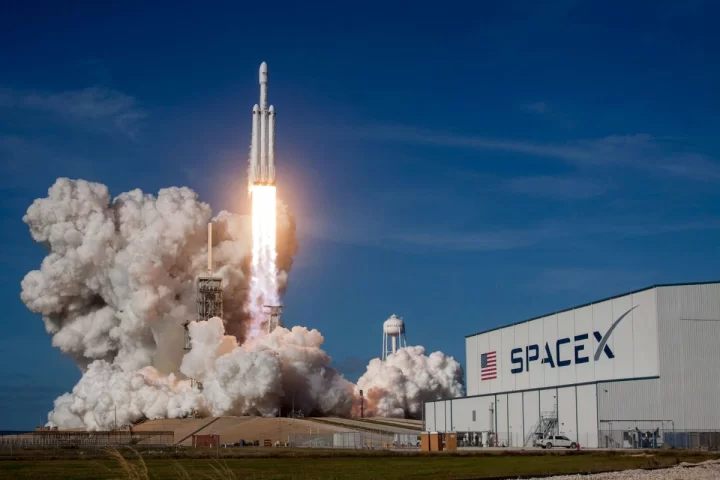
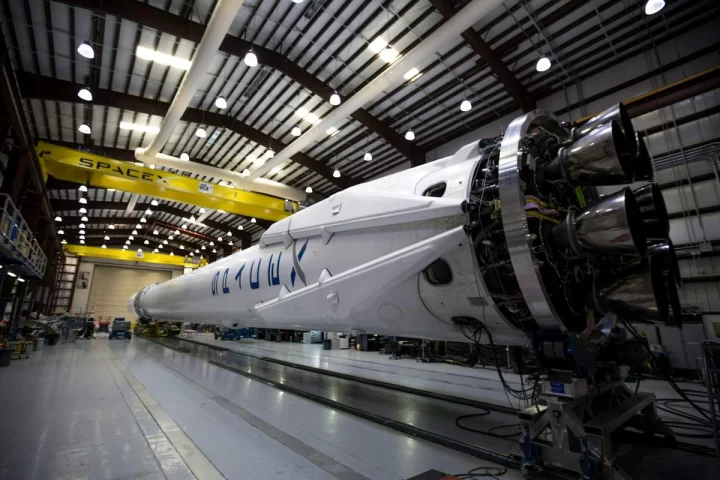
Elon Musk’s SpaceX holds sway over the emerging space economy in a way that has more in common with notorious colonial-era trading companies than the competitive markets of today’s textbooks, according to a new study.
In 2025, SpaceX had a market share of around 75% of everything humanity sent into space, according to calculations led by Dr Alessio Terzi from the University of Cambridge’s Bennett School of Public Policy.
This may surpass the East India Company’s share of global tonnage shipped between Europe and Asia when the British company ruled over India in the 1820s, which research suggests was around 72%.
Terzi, an economist, worked with historian Dr Stefano Marcuzzi to compare space launch data with historical data on major trading companies between 1500 and 1800.
As with “Age of Sail” corporations, SpaceX operates with almost complete autonomy, controlling infrastructure and exploiting legal grey areas to command power over a frontier that typically belongs to nation-states, Terzi says.
He argues that a single private firm may not have held such a grip on a “strategic transport technology” for four centuries.
SpaceX’s share of payload mass reaching orbit exceeds the share of seaborne trade around the Cape of Good Hope controlled by either the Dutch East India Company at its peak in the 1710s (72%) or the French East India Company in the 1750s (19%).
The last time one company had a greater share of a global transport technology may be the Portuguese East India Company, say researchers, which had 100% control of the Cape Route in the 1570s following its discovery by Vasco da Gama.
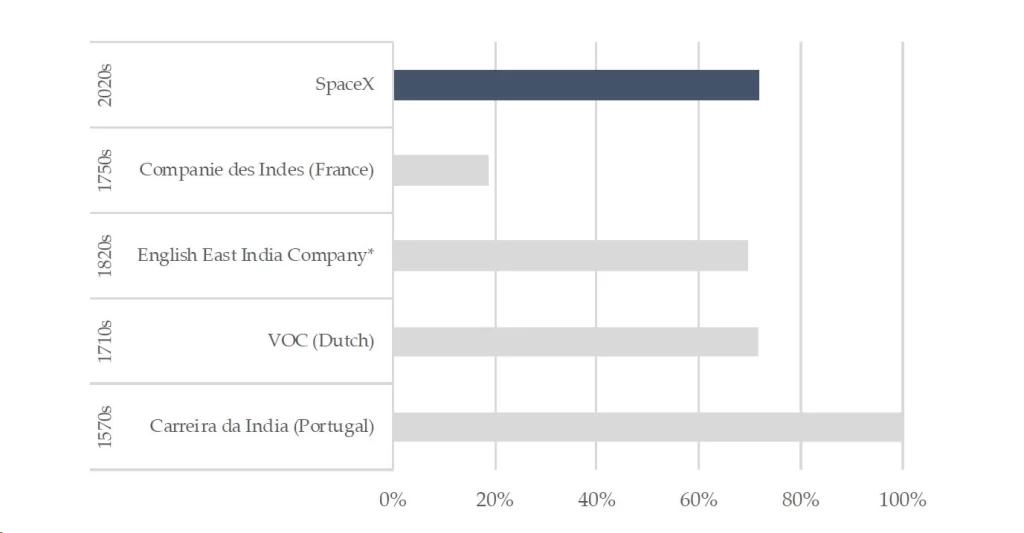
Peak market share achieved in specific decades, SpaceX and East India companies. (Calculations based on based on de Vries (2003), Solar (2013), and Terzi and Nicoli (2026))
“Space is becoming an economic frontier governed by one or two corporations, just as the world’s oceans once were,” said Terzi, who co-authored the new Working Paper.
“Weak international rules and geopolitical competition create conditions for a frontier company to rapidly acquire power that should be reserved for states, leaving governments reliant on a private firm in areas of national security,” Terzi said.
“The US is caught in a trap. Reining in SpaceX would slow America down in the race with China, so no US administration has a strong incentive to do it. The same logic applied to the East India Company in its day.
“History tells us that power and exploitation become so entrenched that states are eventually forced to intervene, by which time the costs of doing so are vast. The East India Company took two centuries to bring under control. Space doesn’t have that long,” he said.
The United States now relies heavily on private launchers for its space access. Last year, 94% of all US launches were done by SpaceX. The rise of private spacefaring has driven a fall in launch costs, says Terzi.
The average cost of launching a kilogram of cargo into low Earth orbit has plummeted in recent years, falling from $15,000 per kilo in the early 2000s to just $4,000 by 2025, according to previous work by Terzi and colleagues.
While, historically, space launch vehicles were one and done, the advent of reusable technology, spearheaded by SpaceX from 2016 onwards, changed the market: more launches meant operational refinement and lower costs.
SpaceX also “manufactured its own demand” by building Starlink: thousands of satellites – and hundreds of rocket launches – to provide broadband in remote areas. Competitors lack both reusable systems and this self-perpetuating market.
This has seen SpaceX’s share of global payload launched into orbit jump from below 10% in 2014 to approaching 80% last year. With close to 10,000 satellites already up, and 42,000 planned, SpaceX is fast absorbing orbital slots and radio frequencies needed by start-up competitors, creating more barriers to market entry.
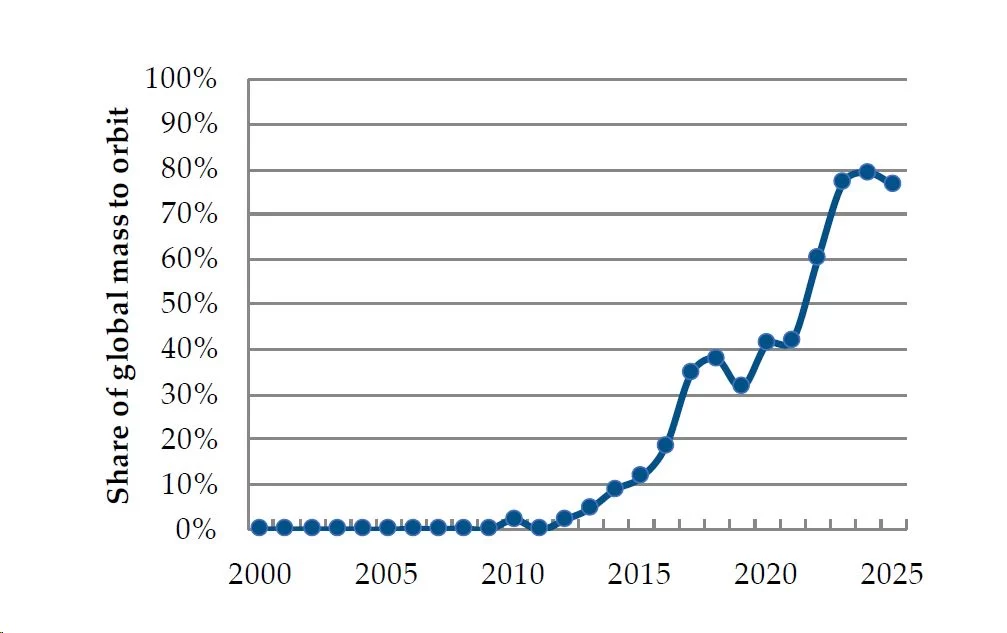
SpaceX’s share of global mass launched to orbit, 2000 to 2025 (Terzi and Nicoli, 2026)
As with East India companies, SpaceX is a private firm deeply embedded in national strategy through military and communications objectives, argue the researchers.
It operates in a region with little authority, creating its own rules, as did colonial-era companies, and is on track to manage much of the access to vital spacefaring waystations such as the Moon, just as the trading companies controlled key ports.
To prevent the dangerous return of corporate-led governance for the space age, Terzi says the US government should use its purchasing power to get competition and data access conditions written into space contracts while there’s still time, and maintain alternative space launch capacities for back-up.
He argues that the US government should take a public equity stake in SpaceX, as it did with Intel over semiconductor manufacturing, and work with its Artemis Accord allies to ensure the entire international bloc doesn’t end up reliant on a handful of private providers.
“The logic of the space race pushes governments to support corporate champions, just as the logic of colonial competition pushed early modern states to empower their chartered companies,” added Terzi.
“The East India Company was eventually reined in, but only after famines, financial crises, and political scandals made it impossible to ignore. By then it had been running parts of India for a century.”
“We know what the East India Company became. We can put structures in place to keep its twenty-first-century successor from the same fate. The window to act is currently open, but history suggests it will not stay that way for long.”
The erosion of state power is already playing out, says Terzi. Last summer, after a personal dispute, Donald Trump threatened to cut SpaceX’s government contracts. Musk then threatened to decommission the Dragon capsule, which would have effectively cut the US government off from the International Space Station.
Read the working paper: ‘Outsourcing the final frontier: Space X, the East India Company and the political economy of space‘.
Original source: University of Cambridge
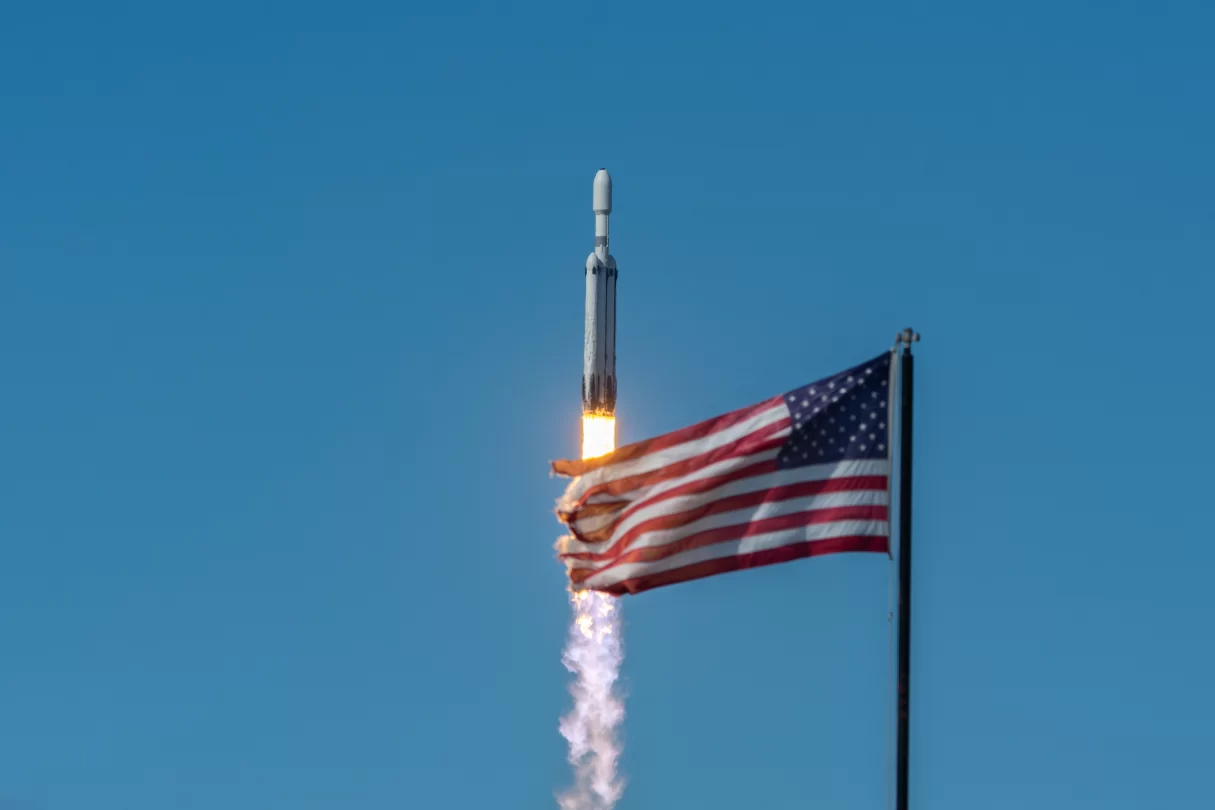
Photo credit: A SpaceX Falcon Heavy passes the American Flag located at NASA’s Launch Complex 39 Press Site as it launches the NOAA GOES-U weather satellite in June 2024. Credit: Brandon Moser via Getty.
The views and opinions expressed in this post are those of the author(s) and not necessarily those of the Bennett School of Public Policy.