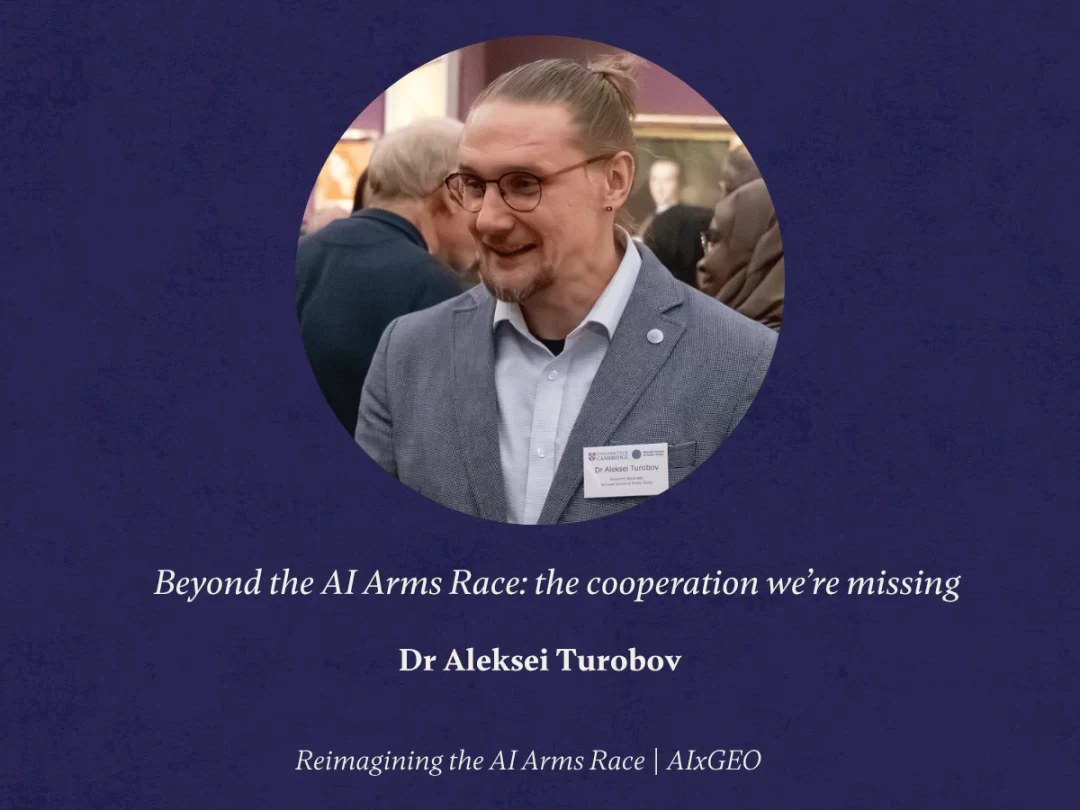
The AI arms race narrative focusing solely on US-China competition means Western policymakers overlook an emerging distributed global governance architecture, writes Dr Aleksei Turbov, Assistant Professor and AIxGeo Research Lead at the Bennett School. Diverse forums, each facing shared challenges, are aligning on the application of AI to solve the same problems, rather than demanding regulatory uniformity. Moving beyond the zero-sum arms race metaphor highlights new forms of power that are enabling a resilient, distributed governance model better suited to managing AI's global risks and benefits.
Washington defines AI leadership by computing scale and dominance, market capitalisation, and benchmark performance of frontier models. Beijing treats it differently – a depth of integration across public services, wide deployment, and embedding the AI technology across sectors with particular emphasis on governing the technology’s use.[1]
This distinction is increasingly recognised, and sophisticated observers acknowledge that Washington and Beijing optimise for different outcomes – development versus deployment, different metrics, legitimate competition along different dimensions. But notice what even this nuanced reading preserves: the frame remains bilateral. We have refined the scoreboard while leaving the two-player game unquestioned, and the US-China binary remains intact.
The binary is the problem. Not because competition doesn’t exist – it does, and dismissing this would be naive. The problem is what the frame renders invisible. While Western policymakers debate whether America or China leads in AI, and what it even means to lead, the global majority is building a different AI governance architecture focussed on domestic solutions to shared challenges. And Western strategy, while fixated on an AI arms race between two superpowers, fails to notice this development.
Different approaches, shared priorities
Over the past two years of working on the AIxGEO project, we have analysed 1,041 policy documents from nine major international bodies – the United Nations (UN), OECD, World Trade Organisation, NATO[2], APEC, ASEAN, the African Union, and the G20[3] – spanning a decade of AI governance development. The prevailing narrative suggested we would find fragmentation: competition driving divergence, institutions splitting along geopolitical lines, the US-China contest forcing ‘choosing sides’ with incompatible approaches. Institutional diversity reinforced this expectation: NATO’s security mandate shares little with the African Union’s developmental agenda and APEC’s economic integration differs from ASEAN’s regional balancing. However, we found convergence.
Forums representing vastly different political systems, developmental stages, and strategic interests are arriving at functionally equivalent governance priorities. They disagree on mechanisms and methods, but they are converging on what AI governance must achieve: algorithmic accountability, workforce adaptation, data protection, security cooperation, climate and health applications. This convergence emerges from shared challenges rather than coordinated negotiation – a distinction with profound implications. Negotiated frameworks depend on sustained diplomatic will, and they can collapse when relationships sour or administrations change. However, structural convergence is more durable. When different institutions facing similar challenges independently arrive at similar priorities, the architecture survives geopolitical turbulence. It cannot be dismissed as a Western imposition when it emerges from forums the West does not control. And it means policymakers need not wait for grand bargains – the foundation for cooperation already exists.
The recognition that governance outcomes matter more than regulatory uniformity is important because governance architecture, once built, shapes what becomes possible. Frameworks established today become the baselines against which future proposals must justify themselves. Institutional channels created now determine whose voice carries in tomorrow’s negotiations. Options that remain open during construction foreclose once the architecture hardens. Western policymakers fixated on race are missing the construction, and therefore the opportunity to influence global AI cooperation.
Consider transparency, the question of how AI systems remain comprehensible and accountable to those they affect. Every serious governance framework addresses this, but the approaches differ markedly. APEC[4] economies emphasise institutional oversight: human decision-makers retain ultimate authority, and policymakers deliberate on the appropriateness of AI-augmented decisions before deployment. This mechanism is procedural – governance through authorisation hierarchies. ASEAN[5], by contrast, mandates disclosure at the point of impact: citizens must know when AI systems affect decisions about them. The mechanism is informational – governance through mandatory notification. The African Union[6] instead demands cultural/regional alignment. AI systems must be explicable within local frameworks of understanding, rather than relying solely on technical transparency measured by external standards, as transparency means nothing if explanations are framed in ways that don’t reflect the local context. The G20[7], working across members with fundamentally opposed interests, adopts principles-based consistency. Adherence to agreed principles, such as human-centricity, accountability, and fairness, enables mutual recognition across jurisdictions without requiring identical implementation.
Four approaches, each with different institutional logics. Yet all achieve the same core outcome: AI decisions that can be examined, contested, and corrected by those they affect. A European regulator and a Singaporean policymaker may struggle to recognise each other’s frameworks as both achieving ‘transparency’ – the mechanisms look incompatible. But the accountability function is preserved, despite the variation in form.
Functional equivalence
This is functional equivalence: the recognition that governance outcomes matter more than regulatory uniformity. It suggests a path through apparent gridlock, in which interoperability becomes possible without forcing the world to adopt a single model. The cooperation space expands dramatically once you stop demanding that partners’ rules mirror yours, and instead start assessing whether their mechanisms provide equivalent protections.
Functional equivalence is an operating principle that enables distributed governance. As different mechanisms can achieve equivalent outcomes, coordination doesn’t require a single authority imposing uniform rules; it works precisely because it doesn’t depend on consensus about methods, only convergence on functions.
This creates a distinctive form of power that a binary AI Arms Race framing cannot see. Governance influence flows not only from technological capability but from convening – hosting the spaces where diverse approaches interact, where precedents form, and where the terms of future cooperation are set. ASEAN’s influence in AI governance exceeds its technological weight because it creates space where American, Chinese, and Indian initiatives should engage on ASEAN’s terms. With Washington, technical cooperation on interoperable standards[8]; with Beijing, engagement with China’s Global AI Governance Initiative[9]; with Delhi, practical capability-building in infrastructure and policy[10] – acknowledgement without endorsement, participation without adoption. The African Union asserts co-design rights in global governance, refusing the role of rule-taker. Its 2022 declaration demanded that Africans articulate their own philosophy, ethics, policies, strategies, and accountability frameworks for AI[11], rejecting imported models in favour of homegrown approaches. By 2024, the African Union explicitly called for global AI governance mechanisms to ‘reflect the perspectives of the Global South[12].’ This is a move from passive participation to insistence on voice at the drafting table.
Those who convene can shape agendas, frame choices, and determine whose concerns structure the debate. Every joint statement creates precedent, every working group opens institutional channels that persist beyond individual negotiations, and every principle endorsed becomes the reference point against which alternatives must justify themselves. The OECD AI Principles were non-binding in 2019. By 2024, they had become the baseline endorsed by the G20, the framework that national strategies reference.
This is political architecture under construction, shaped by a distinct underlying logic. Different institutions bring different capabilities that reinforce rather than compete. The UN provides normative legitimacy and development frameworks. The WTO offers established mechanisms for technology transfer and trade. The OECD contributes policy expertise and standard-setting experience. NATO adds security dimensions and operational accountability. ASEAN provides regional coordination across diverse political systems. The African Union brings developmental priorities and a continental scope. The key to AI cooperation lies not in choosing between competing frameworks, but in identifying and leveraging their natural complementarity to create more effective collaborative approaches.
No single institution commands sufficient authority or capability to govern AI alone. Together, they constitute distributed resilience: an architecture that functions precisely because it doesn’t depend on any single point of coordination. When one pathway is blocked by geopolitical friction, others remain open. When one institution lacks capability in a domain, others compensate.
This architecture extends to domains typically considered zero-sum. NATO explicitly acknowledges “fierce competition”[13] and China’s AI ambitions while simultaneously establishing the Data and AI Review Board to operationalise ethical principles; here, competition and governance cooperation coexist within the same institution, maintained by the same members. ASEAN develops cybersecurity capability, establishing regional norms for AI in intelligence and cyber operations, not despite its multi-alignment strategy, but because of it. Building independent capacity might appear to hedge against partners, but the logic runs differently: if member states depend entirely on one power’s AI systems for critical infrastructure, that power gains leverage over their strategic choices. Security capability preserves autonomy, enabling balanced engagement.
The security argument for cooperation strengthens as the threat landscape diversifies, because the threat landscape itself argues for a distributed response. When capable AI systems run on consumer hardware, and when offensive cyber capabilities require modest infrastructure, the traditional state-centric security framework strains. Non-state actors can pose threats once reserved for nation-states. Asymmetric threats – non-state actors with AI-enabled capabilities, offensive operations requiring minimal infrastructure – demand distributed responses. The distributed architecture these forums are building matches the threat landscape better than any bilateral arrangement.
Challenge-oriented international AI governance
How should Western policymakers engage with architecture they’ve largely ignored? The operational shift is from principles to challenges. Practical cooperation emerges from solving shared challenges, not negotiating comprehensive frameworks that must reconcile fundamentally different governance philosophies. Climate adaptation, pandemic preparedness, and educational technology are domains that appear in the priority lists of every forum we analysed. Specific policy domains emerge as natural bridges for coordinated governance efforts.
In environmental policy, shared climate challenges create compelling cooperation imperatives; in healthcare, technological innovation aligns with universal access objectives; in education, AI-enhanced learning aligns with respect for national educational policy; in agriculture, AI supports both food security and development opportunities; in cybersecurity, shared threats necessitate collaborative solutions. Thus, a domain-specific approach provides concrete entry points for country-level cooperation, delivering concrete benefits to all actors while respecting national sovereignty and security interests.
The convergence is structural: shared challenges with clear stakes, immediate applications, and measurable outcomes. Floods, droughts and/or agricultural disruption do not consult whether governments dismiss climate science as a “hoax” – the operational pressures driving cooperation persist regardless, which is precisely why structural convergence proves more durable than frameworks dependent on political alignment. Geopolitical friction is minimised because cooperation is visibly mutual-benefit rather than zero-sum. For example, the G20 has deliberately treated AI as a shared global project.[14] Each presidency has strengthened a shared AI framework and built on its predecessors’ work. While acknowledging competitive dynamics in the economic and security domains and constructing cooperative norms in AI governance, the G20 has formed an active institutional effort to deliberately insulate AI governance from geopolitical tension.
The Covid-19 pandemic demonstrated how challenge-oriented governance can work. AI systems that might have undergone years of pilot testing were deployed at scale within months. Governance emerged from operational experience – lessons learned during crisis, then codified into durable frameworks. Challenge-oriented cooperation moves faster than treaty negotiation because it starts with shared problems rather than contested principles, and these practical mechanisms already exist.
What the race obscures
The costs of the current blindness are mounting. Western policymakers operating through an arms race lens miss the governance architecture that the global majority is constructing. They misread multi-alignment as indecision rather than strategy, and demand regulatory harmonisation when functional equivalence would achieve cooperation at far lower cost. They cede convening power – the capacity to host the conversations where rules form – to those who understand the actual landscape.
The question is not whether competition will continue – it certainly will, and no analysis changes this. The choice is whether to recognise what else is happening: the architecture taking shape and the convening power accruing to those who show up and engage with it. International AI governance extends far beyond the US-China bilateral and in this wider landscape, capacity building itself becomes governance, creating accountability through partnership rather than compliance through enforcement.
The AI arms race narrative offers a comforting clarity: here is the rival, here is the finish line, here is what winning means. The reality is less simple but considerably more hopeful. A governance architecture capable of managing AI’s risks and realising its benefits is taking shape across institutions that reflect diverse regional variations. Western strategy can help build it, or be built around. The tragedy would be missing that opportunity because we could not see past our own frame.
[1]E. Gibney, ‘China Wants to Lead the World on AI Regulation, Will the Plan Work?’, Nature (2025)
[2]A. Turobov, D. Coyle, and V. Harding, Moving Beyond Competition: Domain-Specific Approach for International AI Framework, Bennett School of Public Policy, University of Cambridge (2024)
[3]A. Turobov, D. Coyle, and V. Harding, Pragmatic Pluralism: Regional AI Governance beyond Great Power Competition, Bennett School of Public Policy, University of Cambridge (2025)
[4]A. Turobov, Beyond Western Paradigms: APEC’s Pragmatic Alternative to AI Governance, Bennett School of Public Policy, University of Cambridge (2025)
[5]A. Turobov, ‘ASEAN’s AI “Third Way” is a masterclass in geopolitical strategy’, Bennett School of Public Policy, University of Cambridge (2025)
[6]A. Turobov, ‘Strategic paradox: how the African Union performs the future through AI policy’, Bennett School of Public Policy, University of Cambridge, 10 September 2025
[7]A. Turobov, ‘The G20’s Quiet Rebuttal to the AI Arms Race’, Tech Policy Press, 12 November 2025
[8]Association of Southeast Asian Nations and United States of America, ASEAN-U.S. Leaders’ Statement on Promoting Safe, Secure, and Trustworthy Artificial Intelligence, 11 October 2024
[9]Association of Southeast Asian Nations, Chairman’s Statement of the 27th ASEAN-China Summit, Vientiane, Lao PDR, 2024
[10]Association of Southeast Asian Nations and Government of India, ASEAN-India Joint Statement on Advancing Digital Transformation, 2024
[11]African Union, ‘Press Release: African Union Cybersecurity Expert Group Holds Its First Inaugural Meeting’, 2022
[12]African Union, ‘Press Release: Education, Peace, Politics, Climate, Economy and International/Global Diplomacy in Focus at 37th AU Summit’, 2024
[13]NATO: Maintaining Security in a Changing World. Speech by NATO Secretary General Jens Stoltenberg – Ambassador Donald and Vera Blinken Lecture on Global Governance, Columbia University (2019)
[14]A. Turobov, ‘The G20’s Quiet Rebuttal to the AI Arms Race’, Tech Policy Press, 12 November 2025
The views and opinions expressed in this post are those of the author(s) and not necessarily those of the Bennett School of Public Policy.