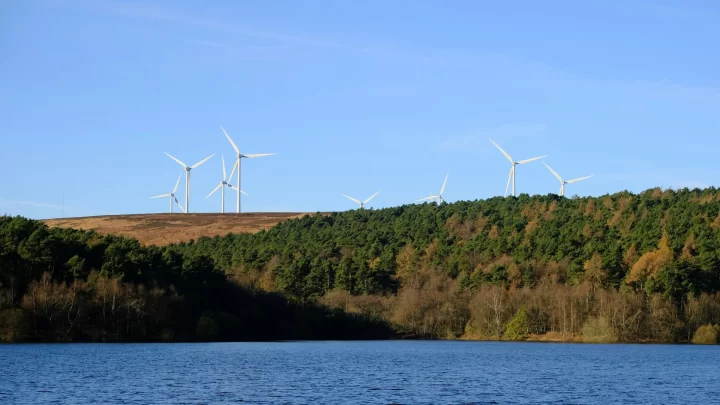
As renewable energy becomes increasingly recognised as an economic asset, Dr Julia Wdowin explores how shadow pricing can capture the wider social value of wind power beyond its market price. Using UK onshore wind data from 2009–2023, she estimates the value of avoided carbon emissions and finds that wind’s contribution to social welfare may be significantly underestimated in conventional economic measures.
Abstract
Shadow prices provide estimates of the economic contribution of capital assets (goods and services) to social welfare. They differ from exchange values in that they aim to incorporate the economic value of externalities associated with some assets. As the revised SNA25 standard explicitly recognises renewable energy resources as economic assets, this paper demonstrates an empirical methodology for estimating the shadow value of wind as a renewable energy asset, and provides estimates of the annual asset shadow value for onshore wind in the UK between 2009 and 2023. The estimates incorporate the value of avoided carbon emissions as a service wind energy provides. The estimated annual shadow asset values are much larger than market price equivalent asset values. While these estimates should be treated with caution due to a number of methodological choices involved, they signal the likely underestimation of the contribution of wind energy to social welfare. The paper concludes by discussing methodological assumptions and data needs for estimating shadow values. The paper provides a modest empirical contribution, whilst methodologically consistent with ONS natural capital accounting for feasible implementation.
Download the paper from the ESCoE website.
Keywords: shadow prices, natural capital accounting, wind, renewable energy, asset
valuation, welfare
JEL classification: D60, D62, E01, Q40, Q51, Q56