UK governments struggle with policy learning because of decades of centralisation. Worse still, lessons from their own commissioned work can be lost and forgotten. Geoff White cites the case of a lost report on the impact of £15bn spent by the English Regional Development Agencies. Yet, learning from the past is now more important than ever given the current political focus on the role of regional institutions in promoting growth.

Nine Regional Development Agencies (RDAs) were set up in 1998 by the UK government to drive growth and regeneration across the English regions. PricewaterhouseCoopers (PwC) was commissioned by the Department for Business, Enterprise and Regulatory Reform to evaluate the impact and value for money of the RDA spend of £15bn over 1999/2000 to 2006/07. Its report published in 2009 concluded that £4.50 in regional gross value added (GVA) was generated for every £1 spent. Yet in the interest of austerity, the coalition government of 2010 abolished the RDAs and the PwC report virtually disappeared along with them.
The lost report
Given the Burnham government’s commitment to devolution as a stimulus to good growth in every postcode, it now seems opportune to dig out the lessons from that report. But the PwC report is not easily accessible. Locating it requires knowledge of its existence and deep internet dives to track it down in the Deposited Papers of the House of Parliament.
A thought experiment
The PwC report provides enough evidence (despite the missing raw data) to carry out a thought experiment. What might it imply for the categories of interventions by devolved authorities and others that are most likely to induce good growth (in jobs and GVA) cost-effectively?
Some caveats are needed. The evidence is dated and relates to regions rather than sub-regions or local areas. It draws on evaluations commissioned by each RDA with a risk of commissioning bias. Some of these evaluations were also criticised for lacking robustness against best-practice standards.
Nevertheless, let’s see where the thought experiment takes us.
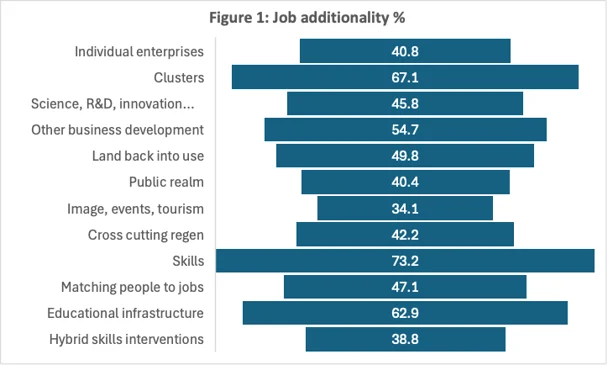
The jobs impact: Figure 1 (using the PwC data for 1999/2000 to 2006/07) shows that interventions like support for Individual enterprises or Image, events and tourism are less likely to generate additional jobs. Highest additionality is achieved for Cluster development, Skills, Educational infrastructure whose outcomes are less likely to materialise at all or only at smaller scale or less quickly if left to private sector investment.
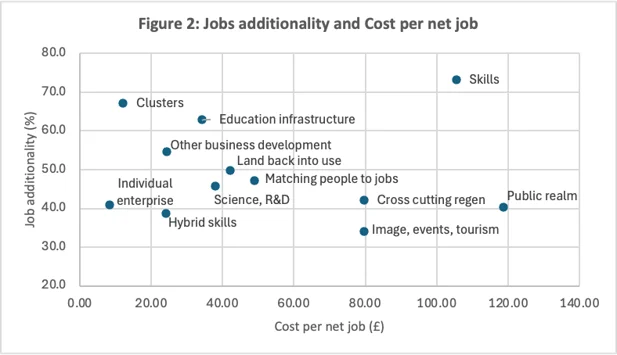
Cost-effectiveness: The message from the data in Figure 2 is that, if you want increased additional jobs, you should think twice about spending scarce funds on Public realm investments or Skills enhancement or promotion of Image, events and tourism. The funds might be better directed at Clusters, Individual enterprises, Other forms of business development, and Hybrid skills development.
The GVA growth engine: Some interventions generate higher GVA and some more so over the longer term. For example, spend on Science and technology, Cross cutting regeneration and the Public realm is, on the PwC evidence, more likely to generate higher GVA over time than in the short term.
If the objective is to generate ‘good growth’ in jobs and GVA with a limited budget, then the data in Figure 3 suggests the focus should be on business development in a variety of forms. It also suggests that less spending is required than for getting Land back into use, Science and R&D, Image, events and tourism, and the Public realm. However, these latter categories offer a good return in terms of additional GVA if not necessarily in terms of jobs. According to this data, skills development doesn’t offer as good returns in jobs and GVA per pound of public spend but it is relatively low cost.
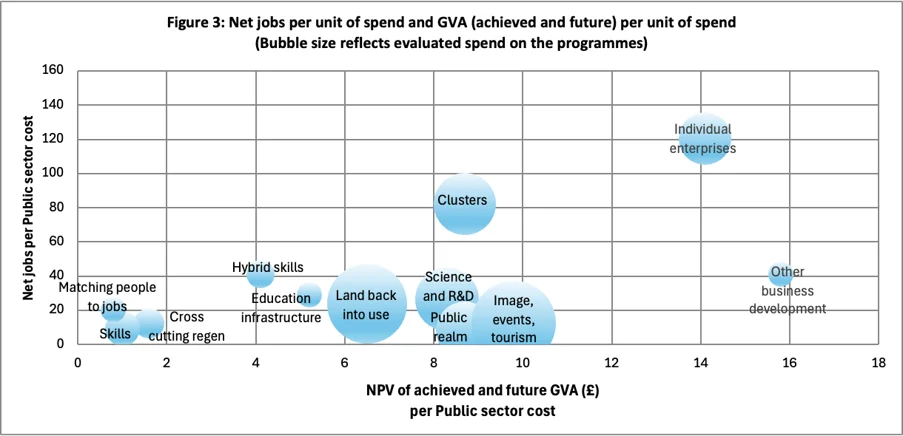
So, this thought experiment using the PwC evidence concludes that, if the aim is to create additional regional jobs with high GVA, then business and cluster development should be a priority within a limited budget. However, the PwC report also found that RDAs could play a strategic role in integrating a range of interventions to promote growth (a component in what PwC – and the RDAs – referred to as their strategic added value[1]). Based on the PwC evidence and commentary, the following headline conclusions could be drawn about the most cost-effective mix of investment by devolved authorities, other agencies and central government.
- Integrated demand and supply side measures: A package of mutually reinforcing interventions is required to address demand side issues (e.g. through business development) and supply side measures to bring land back into productive use and people back into the labour market.
- Business development is about improving productivity but also, crucially in some local areas, increasing jobs through start-ups, SMEs, inward investment, and clusters.
- Sustainable longer-term investments: Whilst crucial, their high costs mean that bringing land back into use, supporting science and technology, developing the public realm and tourism need to be appraised carefully to test their additionality and GVA contribution.
- Education and skills infrastructure: Skills development should focus on improving the education infrastructure and on hybrid skills programmes designed to develop the potential workforce to meet increased demand for high skilled jobs especially in left-behind areas.
Reclaim the lost learning and build on it
The thought experiment demonstrates that historic evidence like the RDA impact evaluation can provide insights into the categories of intervention likely to induce regional growth most cost-effectively. It should be reclaimed, placed clearly in the public domain and built on.
Times have changed of course. The centralised impact evaluation framework within which RDAs were required to monitor performance gave way after 2010 to a more ad hoc localism in which limited resources constrained impact assessment (through Local Enterprise Partnerships).
That overlapped with an era in which performance assessment focused on how competitive, area-based funding pots were allocated and used. Now is the time of devolution and flexible integrated settlements in which evaluation must itself be devolved and designed to assess packages of interventions likely to vary from one place to another.
Over the same period, there’s been a shift in official guidance on performance monitoring to quasi-experimental impact evaluation methods and now to real time, agile learning – as shown in the recent edition of the Magenta Book.
However, this evolution does not mean that evidence from past periods should be discarded or lost. Rather, it should help to tell us what is already known, where the gaps are and refinements needed, and how new evidence can be melded with old to inform decisions about the effective and cost-effective use of scarce public funds to achieve regional growth.
A centralised impact evaluation framework, as adopted for the RDAs, would no longer be acceptable in these devolutionary times, especially if seen to be imposed by Whitehall. However, there needs to be some form of cross-spatial learning where devolved authorities can learn from each other and from the past.
There is an urgent need for a jointly crafted performance framework involving central government, devolved authorities, and experts (such as the What Works Centres). The primary purposes of such a joint effort would be to:
- modernise the framework: the PwC evaluation framework should be refined to accommodate the changes in intervention categories and performance measures that are now more appropriate;
- update it with new evidence: the PWC review, and the 2009 additionality report which drew on it and other sources, should be updated using the evaluation evidence that has accumulated since then;
- account for spatial variations: the review should be extended to cover variations in impact and cost-effectiveness at the spatial levels most relevant to the current devolutionary process (i.e. at sub-regional levels and recognising the needs of hyperlocal areas with high levels of deprivation).
It’s time to pull the evidence out of the archives and put it to work.
[1] The strategic added value components are strategic leadership and influence, leverage, synergy and engagement (see the Executive Summary of the PwC report).
The views and opinions expressed in this post are those of the author(s) and not necessarily those of the Bennett School of Public Policy.