Local governance reform in Scotland is about more than drawing new council boundaries. With both Andy Burnham and John Swinney making similar arguments about regional empowerment, a new area of common interest is emerging between Holyrood and Westminster, offering opportunities for cooperation and creating a new dimension to territorial politics, argues Affiliated Research, Peter Hourston.
Empowering regions is at the front and centre of the new UK government’s agenda. Until recently, however, Prime Minister Andy Burnham’s focus had been almost entirely on regional devolution within England.
Last week, Burnham made his first significant intervention in Scottish politics, taking his philosophy of “Manchesterism” north of the border. In a speech in Lanarkshire, the Prime Minister stated he was open to working with Holyrood to devolve power to Scotland’s regions.
Meanwhile, separate to Burnham’s announcement, concerns around unequal economic performance and public service reform have led to a renewed interest in regional governance within Scottish politics. The SNP minority Scottish government’s proposal for local governance reform would see the existing 32 unitary (single-tier) councils replaced by a two-tier structure of regional authorities focused on “strategic decision-making” and community authorities focused on “those decisions which are most effectively made closest to their impact.”
Regional empowerment offers Westminster and Holyrood the opportunity of a shared agenda
Scotland and England are approaching questions of regional governance from different starting points. A first reading may suggest that they are drifting further apart: while the UK government has recently focused on creating larger unitary councils, the SNP appears to be unwinding the unitarisation of Scottish councils that occurred in the mid-1990s.
But despite political disagreements over elected mayors, remarkably similar pressures are shaping local government reform in both Scotland and England. The Starmer government’s English devolution white paper from December 2024 argued that local government reorganisation was a prerequisite for devolution: a streamlined structure of unitary councils working together in a strategic authority led by a directly elected mayor. There is a parallel in the proposed relationship between regional and community authorities in the Scottish government’s proposal.
Supporting economic growth has also been a strong motivator for regional empowerment. The Scottish government has proposed that the new authorities would have an “enhanced role in regional economic development and business support”. Burnham’s desire to see “good growth in every postcode” is at the core of his commitment to further regional devolution.
There is also a pressing financial imperative on the part of both governments. The Scottish government faces a projected £4.7bn spending shortfall by 2029-30. The Scottish government may decide it is preferable (or perhaps unavoidable) to undertake structural reforms alongside expenditure reductions.
In England, where seven councils have gone bust in recent years, unitarisation has been seen as an imperative to drive down costs. Whether either approach ultimately succeeds in easing financial pressures is an area which will deserve further research.
The more striking divergence is the process each government has taken to approaching reforms. The Scottish government would appear to be looking at a one step process: splitting the current unitary councils into regional and community authorities concurrently.
Whereas in England, the UK government followed a split process with LGR sitting in a separate programme of work from regional devolution and the creation of more directly elected mayors. Clear requirements were stipulated for unitarisation, including a minimum population size of 500,000 for new single-tier authorities.
By contrast, the Scottish government’s proposal is much vaguer. The suggestion of six to ten regional, and 120-160 community, authorities is merely an “opening proposition” and ministers have stressed that they do not wish to be “prescriptive”.
Applying the English criteria to Scotland (with its population of 5.5 million) would result in a maximum of 11 unitary councils – only slightly above the range envisaged for the regional authorities. Under the Scottish government’s suggested number of community authorities, these would have an average population size in the range between 34,000–46,000.
There is clearly a difference in scale, but as Scotland has a population of only around a tenth of England, it can be hard to compare the two countries on numerical metrics alone. Despite distinctions in style and temperament, on the substance there are shared challenges are pushing the UK and Scottish governments towards LGR.
Regional devolution and constitutional politics
The more prosaic matters of drawing municipal boundaries have usually been overshadowed in Scottish politics by the debate on independence. However, that doesn’t mean the constitutional question is entirely removed from either the Scottish government’s recent proposal or Burnham’s speech last week.
The most politically significant aspect of the Scottish government’s regional initiative was Swinney’s pitch to use the idea of devolution within Scotland as a means of coaxing further powers out of Westminster. The first minister commented that he is “open to devolving powers over a broad range of economic levers to…regions, including, where relevant, new powers that are devolved to Scotland from the United Kingdom”. There is clear synergy with the prime minister’s own thinking.
The complementary approaches of Swinney and Burnham each have historic precedent. In the 1990s, the SNP came to support New Labour’s legislative devolution as the party’s then leader Alex Salmond saw Holyrood as a stepping stone to independence. Prior to the 2014 referendum vote, the main pro-Union parties made what became known as the “Vow”, a commitment to more powers for the Scottish parliament, to stave off support for separation.
With a second independence referendum off the table in the short term, turning attention to regional governance is politically useful for both governments. For the SNP, which faces pressure from supporters to secure further constitutional change, engaging constructively with the UK government on matters of shared interest opens the door to discussions with Burnham on more powers for Scotland.
The Prime Minister has much to gain from close cooperation with the Scottish government on regional policy; possibly paving the way for similar opportunities in Wales and Northern Ireland to demonstrate that re-wiring the state is a UK-wide agenda rather than simply an English one. But Burnham has also used the opportunity to draw attention to the SNP’s tendency to centralise control at Holyrood, as shown by the merging of regional police and fire services and underfunding of local councils; a contrast he would argue from his own record in Greater Manchester.
Notwithstanding Swinney’s relatively warm reaction to the Prime Minister’s speech, and Burnham’s recognition of the Scottish government’s proposals, any hope of collaboration could be derailed. Burnham’s desire to allow places more control over their destiny does not extend to permitting Holyrood to hold a second independence referendum, which the SNP will want to emphasise. An underlying prospect that a UK general election – with an uncertain outcome – could be just around the corner means that the raw politics of the Union will never entirely disappear.
The relationship between Holyrood and Westminster has long been overshadowed by rows over the distribution of power between them. But the confluence of Scottish and UK government initiatives on regional policy creates a window of opportunity towards a more practical, partnership-based approach to intergovernmental relations. Whether that happens in practice remains uncertain, but regional governance clearly adds another dimension to territorial politics.
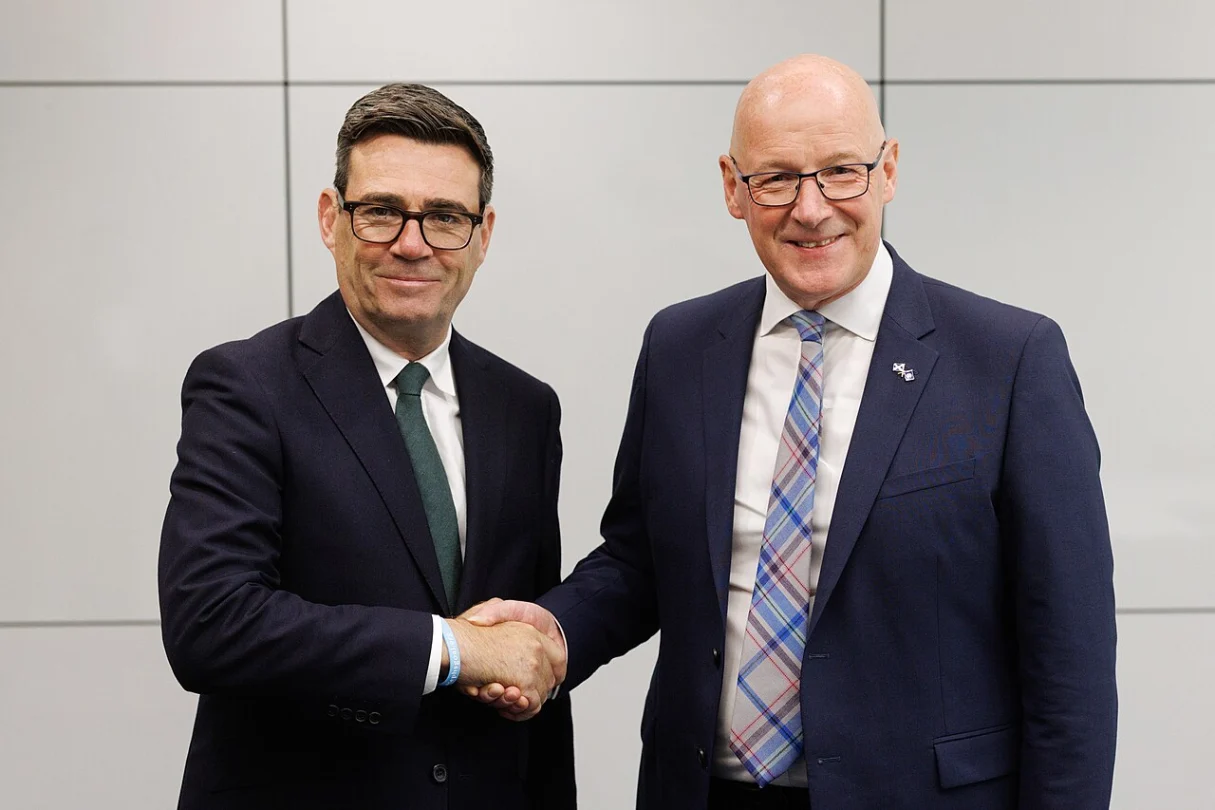
Image: Glasgow, United Kingdom. Prime Minister Andy Burnham bilateral meeting with John Swinney, First Minister of Scotland visit to Glasgow on 23 July 2026. Picture by Simon Dawson / No 10 Downing Street.
Source: https://www.flickr.com/photos/number10gov/55414125885/in/photostream/
Open Government License 3
The views and opinions expressed in this post are those of the author(s) and not necessarily those of the Bennett School of Public Policy.