Decades of centralisation have locked UK governments into policy learning based on a "command-and-control" culture that leads to serious policy blunders, writes Geoff White. This limits their effectiveness and adaptability in the face of major crises. ‘Devolution plus’ as championed by Andy Burnham offers a potential escape from the restriction of hierarchy to a more resilient, learning state.

UK governments suffer from severe and systemic blockages to policy learning. Echoing the findings of King and Crewe ten years earlier on the causes of government blunders, the Institute for Government (IfG) observed in 2024, “too much policy remains unhelpfully closed to evidence and input, particularly from outside central government”.
Over the last four decades the UK has become one of the most centralised large economies in the developed world. It has been described as an “incoherent state” – all “hub no spokes” – with highly centralised policy design and fragmented delivery. Constrained to the “shadow of hierarchy“, UK governments have shown limited capacity or willingness to pivot to other forms of learning – from delivery agencies, local authorities, independent experts, stakeholders and citizens.
The adverse effect of this became clear during the Covid-19 crisis. The trace part of the UK ‘test and trace’ system was based on a central model developed for testing despite the absence of a business case to justify it and, initially, without engagement of local authorities and NHS primary care bodies despite their existing networks and expertise. On the use of scientific advice, “those who want to see ‘evidence-based’ policy can take little comfort from the Covid-19 experience: evidence is still processed in non-transparent ways, from which policy emerges”. A BMJ editorial concluded that the COVID inquiry demonstrated “governing structures and cultures struggling to shift from hierarchical government … towards a more network-based culture that empowers people to span sectoral and jurisdictional boundaries”. This was costly. Ineffective use of evidence at the centre led to poor public health and economic outcomes (IFG)).
Breaking out of the shadow of hierarchy will require action on at least three fronts.
Devolving policy learning
Moving beyond a top-down model of governance requires devolving policy learning and strengthening local levels of government. Inter-governmental dialogue is a mode of learning in which agencies share and trade information collaboratively but also to secure funding and achieve their objectives (Dunlop and Radaelli).
We saw this happening in Greater Manchester where dialogue with central government was not confined to centrally imposed requirements but used proactively to drive and test local ambitions and policies for development. As a What Works Growth report observed, evidence development was “not seen as a luxury but central to the development and refinement of policy across the city”. Should Andy Burnham become Prime Minister, we can expect to see an increased drive for such devolved forms of learning.
However, its effectiveness will depend on the learning capacity and inclination of local authorities. These need to be rebuilt in the UK after many years of centralisation and reductions in their funding in real terms. Increased resources and capacity are required but also strengthening of incentives to motivate local government to pursue evidence-based policy. A mix of initiatives is needed to achieve this:
- Promotion of fiscal devolution so that local authorities become responsible for revenue raising – strengthening their incentive to learn.
- Enhancing local learning capacity by, for example, increasing and extending the Mayoral Capacity Fund and scaling it up to benefit multiple authorities.
- Encouraging reflexive learning through greater use of citizens’ assemblies and participative evaluations.
Recasting central government guidance
Government guidance manuals currently institutionalise the disconnect between policy design, delivery, and evaluation. The Green Book focuses on appraisal; the Teal, delivery; and the Magenta, evaluation. They need to be recast to prompt more continuous policy development and less hierarchical modes of learning along the following lines.
All the manuals – including a fourth, The Amber Book, for crisis management – need to be brought into one overarching analytical and management framework for policy development along the lines of the Gate Review process which requires staged reassessments of the strategic case for major infrastructure projects.
Policy development should be depicted as a continuous process. The policy cycle is currently presented as in Figure 1 promoting single-loop rather than continuous double-loop learning. It evaluates performance at the tail end of a project, encouraging officials to ask the quite often defensively answered question, ‘did we do things right?’ rather than ‘are we doing the right thing?’
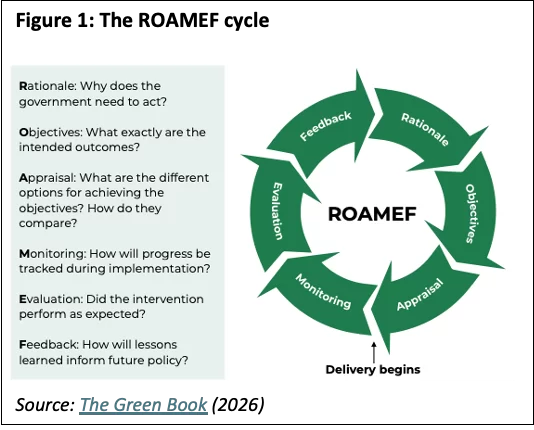
The latest Magenta Book introduces ‘test and learn’ to check and refine business case and appraisal assumptions early. This is very welcome but it is designed for pilots and is not yet widely used. Generally, evaluation is still seen as objective driven. Developmental evaluation is only fleetingly referred to and double/triple learning feedback loops are not explicitly or routinely set out in the guidance.
Ongoing learning needs to be recognised in the guidance on crisis management and be more broadly based. The Amber Book does not disguise its hierarchical approach. An acute crisis requires activation of COBR (i.e. the highest level of government) and the adoption of ahierarchical “command, control and coordination structure”.
This is depicted in Figure 2 from the Amber Book where it is presented as an inverted pyramid perhaps to reflect one of its declared principles – subsidiarity. But local agencies are seen as in need of support rather than, as they should be, as sources of evidence, innovation and solutions. There is no hint of mutual support and learning feedback loops between the levels. Indeed, learning feedback is not referred to at any point in the Amber Book. If this guidance was followed, it’s no real surprise that a centralised model for the test and trace programme was taken as the default option.

Guidance is required on rapid learning. Continuous policy development and effective crisis management need rapid (‘good enough’) learning methods with results updated frequently and presented in a suitable format for briefing of ministers and senior officials to reassess policy choices. Guidance is needed on this in general and specifically on how AI can be used in a Bayesian process to update success/failure probabilities as real-time evidence emerges.
Devolution might offer a way out of the shadow of hierarchy. But there’s a risk we might end up with spatial as well as departmental silos. Horizontal structures and cultures for learning are needed so sub-national agencies can learn from each other rather than lessons being mediated, often inadequately, through the centre (Mulgan (2026)). The Test, Learn and Grow programme is exploring this with local agencies at relatively small scale and the What Works Centres doing so within some policy areas. But a more radical initiative is required.
The Cabinet Office and HM Treasury should launch a horizontal initiative, drawing on Test, Learn and Grow and the What Works Network, to understand complex issues like the persistence of spatial inequalities in the UK and to set out effective policy responses across functional and spatial silos to address them, drawing on a diversity of experience, expertise and learning.
Building a more resilient and modern state of learning will take some time given how long UK governance has operated in the shadow of hierarchy. However, it is essential to deal with an increasingly uncertain world and the crises it generates. Blundering through is not an option.
Image: Monet – The Houses of Parliament (Effect of Fog) – with frame – Category:Paintings by Claude Monet in the Metropolitan Museum of Art – Wikimedia Commons. This file is made available under the Creative Commons CC0 1.0 Universal Public Domain Dedication. The person who associated a work with this deed has dedicated the work to the public domain by waiving all of their rights to the work worldwide under copyright law, including all related and neighboring rights, to the extent allowed by law. You can copy, modify, distribute and perform the work, even for commercial purposes, all without asking permission.
The views and opinions expressed in this post are those of the author(s) and not necessarily those of the Bennett School of Public Policy.