The rapid adoption of Artificial Intelligence (AI) is driving unprecedented demand for data centres, putting their environmental footprint at the centre of public and political debate, and for good reason. Is putting data centres into space a realistic solution?
Global data centre electricity consumption is projected to rise from 415 TWh in 2024 to over 945 TWh by 2030: a projected total roughly equal to Japan’s current electricity consumption. Combined with substantial water consumption for cooling, this growth could place unsustainable pressure on the energy grid and local water resources. Against this backdrop, some AI hyperscalers have touted the possibility of moving computing infrastructure to space as a potentially resource-neutral option. Despite significant technical challenges, advances in launch technologies and the successful deployment of large satellite constellations suggest that orbital data centres could indeed become a viable option in the near future.
Operating computing infrastructure in space would undoubtedly reduce emissions from power consumption and cooling; however, deploying it would drive rocket launches to an unprecedented scale. Evidence suggests that, in addition to emitting substantial amounts of greenhouse gases, rocket launches can disperse black carbon and soot across different atmospheric layers, potentially depleting the ozone layer and posing risks to Earth’s climate that are not yet fully understood.
Research at the Bennett School has developed a comprehensive dataset of historical rocket emissions, helping policymakers understand the real-world trade-offs of moving computing infrastructure to orbit. In what follows, we provide some preliminary results.
The feasibility of space-based data centres
Substantial technical challenges remain for space-based computing, including maintaining hard-to-access infrastructure, mitigating debris and collision risk, and navigating regulatory and security hurdles in increasingly congested and contested orbits.Despite these challenges, rapid advances in deployment technologies and clear operational benefits suggest orbital computing is increasingly feasible and attractive.
Reusable launch vehicles are improving the financial viability of deploying major space infrastructure. The launcher market is currently dominated by SpaceX’s Falcon 9 rockets, which reuse both their first stage and payload fairings, significantly reducing hardware replacement cost. Further cost reductions could follow from SpaceX’s next-generation rocket, Starship, designed to deliver over 100 tonnes to lower orbits in a fully reusable configuration, about five times the payload of a Falcon 9. If achieved, this combination of reusability and payload capacity could significantly lower deployment costs and determine the feasibility of deploying space-based computing.
While operationally challenging, orbital computing could benefit from unlimited energy and cooling capabilities, two of the major constraints facing Earth-based systems. In fact, servers mounted on satellites in dawn-dusk sun-synchronous orbits would be powered by solar panels that receive consistent sunlight. Meanwhile, radiative cooling technologies, currently under development, could passively remove heat through infrared radiation. Finally, while latency in relaying data from orbit poses an obvious challenge, mega-constellations (large networks of satellites operating in low Earth orbits) already provide high-bandwidth, low-latency broadband from low orbits, providing a proof of concept for most AI applications.
As deployment costs may fall over the coming years (Terzi & Nicoli, 2026), and given the benefits of operating computing in orbit, orbital data centres appear increasingly financially and technically viable. Pilot projects are already underway, including Google’s Suncatcher and SpaceX’s Starmind; startups such as Starcloud are raising substantial capital, and China has also entered the race, announcing a “space cloud” by 2030.
Environmental trade-off of rocket designs
As the financial and technical case for space-based computing improves, the claim that it would largely solve the high environmental cost of operating ground-based data centres must be weighed against rockets’ emissions.
Rocket launches contribute to atmospheric pollution by emitting greenhouse gases, particulate matter, and chemically reactive compounds. Furthermore, pollutants released directly into the upper atmosphere can have different atmospheric lifetimes and climate effects than those emitted at ground level (Dallas, & al., 2020) (Ross, & al., 2010). For example, chlorine and black carbon deposited in the upper atmosphere can significantly harm the ozone layer (Brown, & al., 2024).
In our dataset, we classify rocket launches according to the propellant types used in their stages, distinguishing between solid propellants and four major categories of liquid propellants: methane, kerosene, hypergolic, and hydrogen.
Historically, the most popular propellant types have been solid, kerosene, and hypergolic, each presenting unique technical advantages and environmental constraints. Kerosene is currently the most utilised fuel source, offering high propellant density and proven reliability (see Figure 1). As such, its adoption has rapidly increased in recent years, especially because it is the fuel chosen to power Falcon 9’s Merlin engines. Nevertheless, it produces a high quantity of greenhouse gases, soot and black carbon during combustion, making it one of the least environmentally friendly options (Ross, & al., 2010). Solid propellants are often chosen as they enable lower engine and propellant storage complexity but provide limited controllability and restart capability compared to kerosene and hypergolic propellants (Sutton & Biblarz, 2016). Solid motors are also environmentally polluting, emitting significant quantities of alumina particles and hydrogen chloride, which can impact the ozone layer. Finally, hypergolic propellants, such as hydrazine and nitrogen tetroxide, enable highly reliable ignition, although they offer lower performance compared to kerosene. Hypergolic propellants also raise unique environmental and health concerns because of the toxicity of their components (Sutton & Biblarz, 2016).
As an alternative to kerosene and hypergolic propellants, liquid hydrogen offers higher efficiency, high specific impulse, and the lowest overall environmental impact because its combustion produces mostly water vapour. Nevertheless, hydrogen propellant requires bulky cryogenic storage, significantly increasing vehicle complexity (Sutton & Biblarz, 2016) and costs; as such, while chosen to propel the main stage of large, high-profile vehicles such as the Space Shuttle and configurations of Europe’s Ariane and China’s Long March (Chang Zheng) rockets, hydrogen is almost never the preferred option when trying to optimise cost per mass carried.
A final propellant option is methane. Methane, historically overlooked in favour of simpler kerosene and hypergolic designs, offers good performance, lower soot formation than kerosene, and strong compatibility with reusable engine designs. Methane is already emerging as a leading propellant for next-generation launch vehicles, including SpaceX’s Starship, as well as China’s reusable Long March 12A and the first stage of Blue Origin’s New Glenn rocket.
Figure 1: Total fuel mass burned per year and per propellant type, in metric tonnes
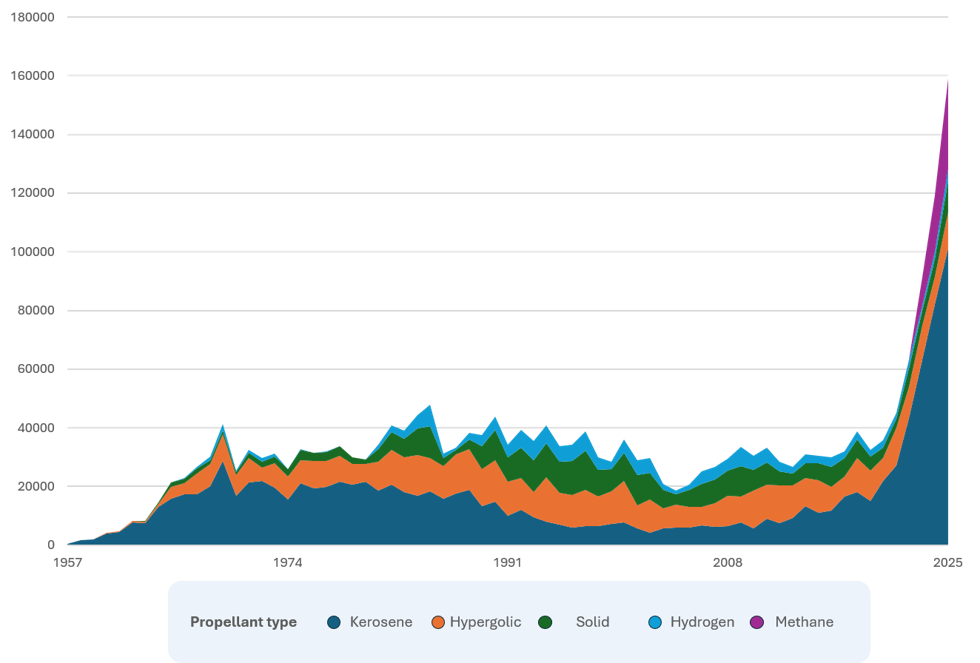
Source: Author’s calculations
A new space race and its environmental risks
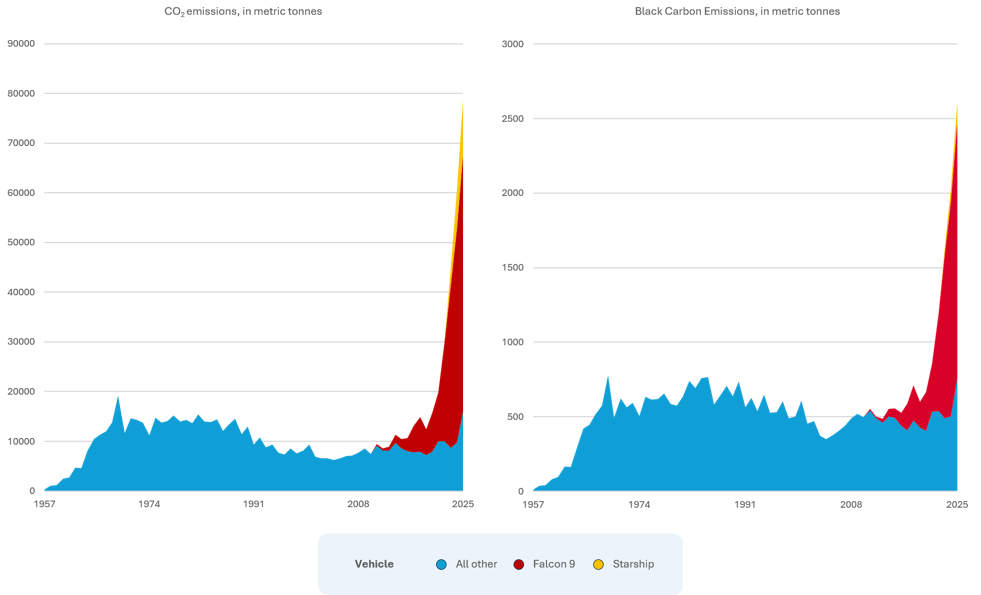
Our data show a rapid increase in CO₂ and black carbon emissions associated with Falcon 9 and the deployment of telecommunication mega-constellations (see Figure 2). Future demand for computing-related launches could lead to a further exponential spike in emissions.
Figure 2: CO2 and black carbon emitted per year by rockets, in metric tonnes
Source: Author’s calculations
While existing information is highly speculative, deploying AI infrastructure in orbit will likely require hundreds of launches of Starship or comparably super-heavy rockets.
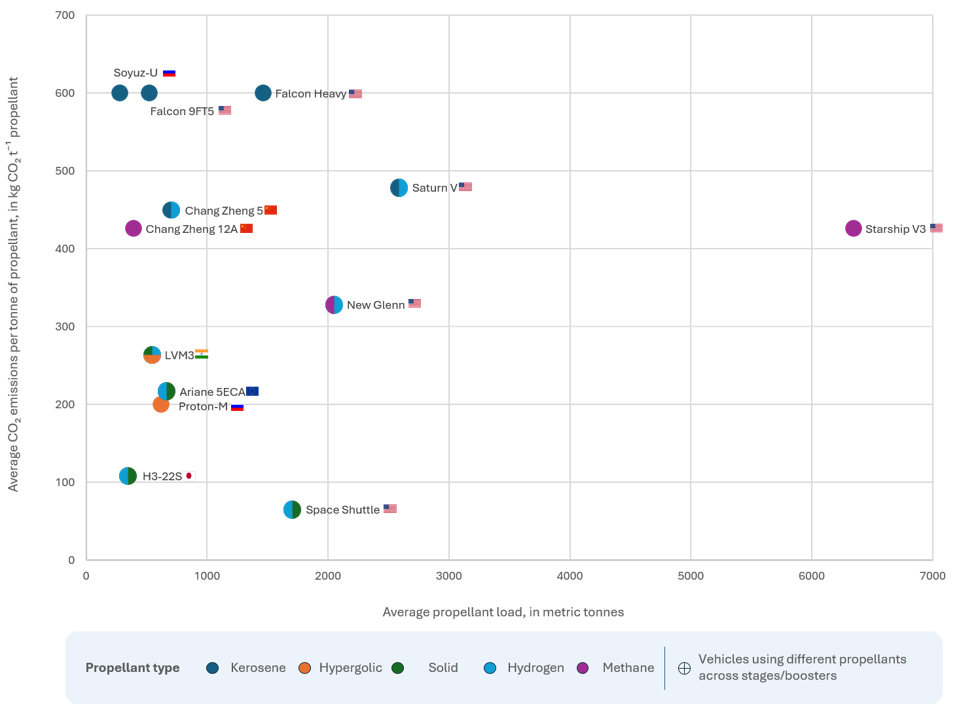
Although Starship’s methane engines burn more cleanly than Falcon-9’s kerosene ones, they still produce substantial CO₂ emissions, as well as black carbon and other pollutants. Furthermore, methane-propelled rockets are, on average, larger systems, burning more fuel. The Starship V3 could carry as much as 6,000 tonnes of methane (Herberhold, & al., 2026), compared with roughly 1,500 for Falcon Heavy, the heaviest lifting kerosene rocket currently operational (see Figure 3).
For this reason, although only a handful of Starship launches have occurred, they already account for a significant and growing share of rocket-related pollution, hinting at a potentially unprecedented growth in emissions across all atmospheric layers if Starship-led space infrastructure is deployed.
Figure 3: Comparison of fuel requirement and average CO2 emissions of a sample of medium and heavy-lift rockets
Source: Author’s calculations
The question for policymakers, therefore, is not simply whether space-based computing can alleviate local pressures such as water and electricity consumption, but how to manage the environmental costs that rapid growth in launches could create elsewhere.
This matters because, if market forces alone determine the scale and speed of deploying space-based computing, private actors will have strong incentives to prioritise the lowest-cost launch options. Super-heavy methane-propelled rockets could be among the leading options for reducing launch costs per unit of payload, but the cheapest rocket is not necessarily the one that best balances cost, efficiency and environmental impact.
Rockets are modular systems, and there is ample room to design vehicles that better balance performance with environmental effects at different altitudes. For example, New Glenn’s hydrogen-fuelled upper stage could reduce black carbon emissions at high altitudes compared with an all-methane Starship configuration.
Policy intervention could therefore focus on updating environmental standards to better account for the differing atmospheric impacts of rocket emissions, while creating incentives for lower-emission solutions at different atmospheric altitudes. Setting the right standards today is critical because infrastructure and supply chains can become locked into specific pathways for decades: payloads may be designed around a particular rocket’s capabilities, while launch infrastructure and performance expectations develop around that choice. The long-standing dominance of kerosene-fuelled launch vehicles illustrates how particular propulsion technologies can become established over time, even when alternatives such as methane offer potential environmental advantages. Without appropriate incentives, the same lock-in could occur with methane-based systems today, potentially limiting the adoption of less-polluting alternatives in the future.
By showing the scale and rapid growth of past emissions, our dataset can help policymakers compare technological options, identify potential trade-offs and determine where policy intervention could have the greatest effect.
Moving infrastructure beyond Earth does not mean deleting its environmental footprint, although it risks moving it out of sight: today’s policy choices will shape not only how quickly the sector develops, but also its long-term environmental trajectory.
Works cited
- Barker, C., Marais, E., & McDowell, J. (2024). Global 3D rocket launch and re-entry air pollutant and CO2 emissions at the onset of the megaconstellation era. Nature.
- Brown, Bannister, Revell, Sukhodolov, & Rozanov. (2024). Worldwide Rocket Launch Emissions 2019: An Inventory for Use in Global Models. Earth and Space Science.
- Dallas, Raval, Gaitan, A., Saydam, & Dempster. (2020). The environmental impact of emissions from space launches: A comprehensive review. Journal of Cleaner Production.
- Herberhold, M., Bussler, L., Sippel, M., & Wilken, J. (2026). Comparison of SpaceX’s Starship with winged heavy‑lift launcher options for Europe. CEAS Space Journal.
- Ross, Mills, & Toohey. (2010). Potential Climate Impact of Black Carbon Emitted by Rockets. Geophysical Research Letters.
- Sutton, & Biblarz. (2016). Rocket Propulsion Elements, 9th Edition. Wiley.
- Terzi, A., & Nicoli, F. (2026). From Sputnik to Starship: Estimating the experience curve of space launch technology. PNAS Nexus.
The views and opinions expressed in this post are those of the author(s) and not necessarily those of the Bennett School of Public Policy.